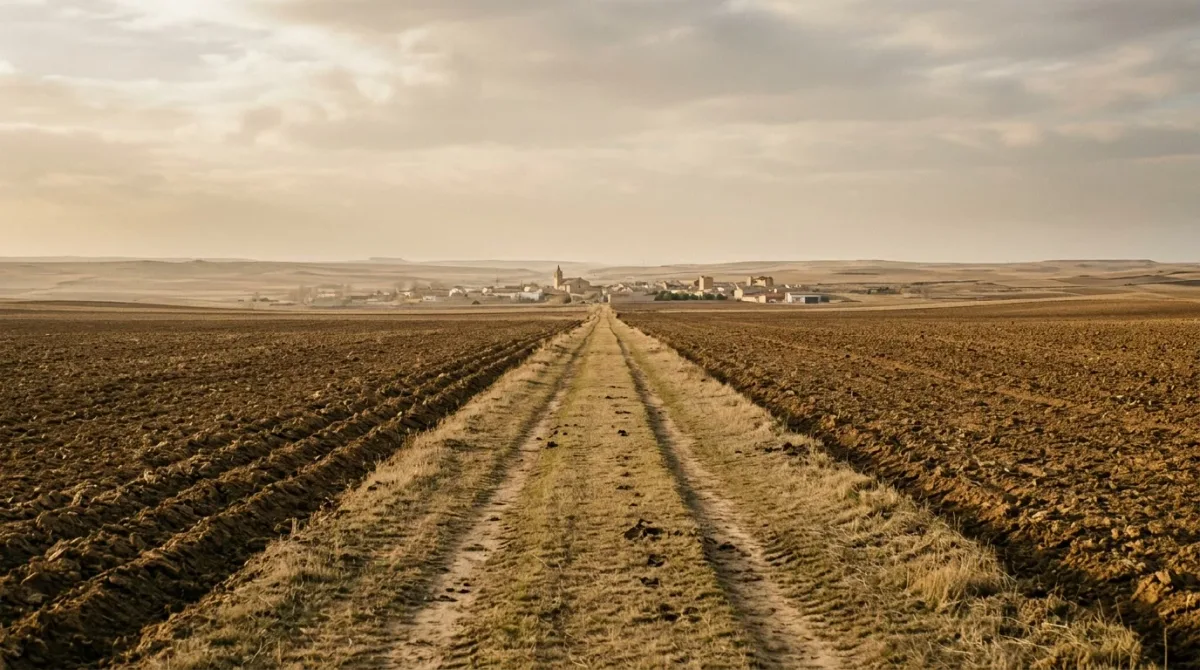
Spain maintains more than 125,000 kilometres of road that no car may legally use. These are the vías pecuarias, the drove roads laid down for livestock moving between summer and winter pasture, and the Ministry for the Ecological Transition puts their combined surface at some 425,000 hectares — a public estate the width of a country, kept open for animals walking.
The arithmetic of that estate is written into statute. Spain's Ley 3/1995 de Vías Pecuarias defines them in its first article as routes along which livestock traffic has traditionally passed, then sorts them by width: a cañada may run up to 75 metres across, a cordel up to 37.5, a vereda up to 20. Article 2 places them in the public domain of the autonomous communities and declares them inalienable, imprescriptible and beyond seizure. They cannot be sold. They cannot be lost through disuse. A road for sheep, in Spanish law, is closer in status to a river than to a lane.
It is an unusual thing for a modern state to guarantee — a corridor seventy-five metres wide, running for hundreds of kilometres, whose only function is to let animals pass twice a year. The width is not decorative. It is the space a flock needs to graze as it moves, feeding on the verge rather than stopping to be fed, which is the whole economic logic of walking livestock instead of trucking it.
In 2023, UNESCO's Intergovernmental Committee inscribed transhumance on the Representative List of the Intangible Cultural Heritage of Humanity, in a multinational nomination joining Albania, Andorra, Austria, Croatia, France, Greece, Italy, Luxembourg, Romania and Spain. The UNESCO listing describes the practice plainly as the seasonal movement of people with their livestock between geographical or climatic regions, undertaken in spring and autumn, on foot or on horseback, herders leading with their dogs and sometimes accompanied by their families. What is inscribed, the listing makes clear, is not the animals or the scenery but the knowledge: a deep understanding of the environment, and the social practices and rituals bound up in breeding, training and the management of shared natural resources. Transmission, it notes, now runs through workshops, universities and research institutes as well as through families.
That last detail is the quiet one. A practice that once passed from a shepherd to a child walking beside him is now, in part, a curriculum.
The most visible surviving expression of the Spanish network is an urban one. Every autumn, shepherds drive a flock through the centre of Madrid, down streets that were open country when the right of passage was agreed. Time, reporting on the 2016 edition held on 23 October, traced the ceremony to a 1418 agreement permitting animals to cross the city on payment of a toll of 160 maravedís, and noted that a few shepherds still hand over the medieval coin in memory of the deal. The same report recorded the scale of the change around that gesture: numbers down from a million to a few thousand. The Ministry of Agriculture, it noted, has promoted the festival since 1994.
It would be easy to file the Madrid drive as pageantry, and in the ordinary sense it is: costumes, crowds, a road closure, a photograph. But the toll is not symbolic in the way a re-enactment is symbolic. The payment is what keeps the right alive. A servitude exercised is a servitude retained; a route walked once a year is a route that has not lapsed. The sheep in Madrid are doing legal work.
What the drove roads carry, besides livestock, is harder to see and has taken scientific instruments to establish. A 2019 study published in PeerJ by García-Fernández and colleagues examined populations of the plantain Plantago lagopus along the Conquense Drove Road and compared them with populations stranded in the surrounding agricultural matrix. Plants growing on the drove road showed lower inbreeding — a mean coefficient of 0.08, against 0.11 in the matrix — and the corridor appeared to function as a reservoir for pollinators, reducing rates of self-fertilisation. Populations near human settlements emerged as dispersal hotspots.
The authors also put a figure on the freight. A flock of a thousand sheep, they estimated, could move on the order of two million P. lagopus seeds northward per day of transhumance, and some fifty thousand southward. The asymmetry follows the season: what the animals pick up in one pasture they set down in another, hundreds of kilometres away, and the direction of travel decides which way the plants go.
The same study found that historical migration rates among these plant populations were higher than contemporary ones — a genetic record, in other words, of transhumance in decline. The flocks are the mechanism. Fewer flocks, less gene flow. The botany keeps the books.
Spain's environment ministry describes the network today in exactly these dual terms. Its official account of the vías pecuarias sorts the national network into the great cañadas reales, inter-regional and cross-border routes, and routes of special interest, and lists their present functions as livestock transit, ecological corridor, green infrastructure linking natural spaces, rural recreation, and cultural heritage tied to transhumance. It acknowledges that traditional pastoral movement has fallen away, and notes the initiatives now working to continue or resume it.
Reading the ministry's list, the order is telling. Livestock transit comes first, because the law requires it to; the ecological argument arrives second, historically the newcomer, and is now the reason many people outside farming have heard of the roads at all. A corridor built to feed sheep is being asked to carry pollinators, plant genes, walkers and the idea of a landscape connected end to end.
None of this is nostalgia, or at least it does not have to be. The drove roads are not a ruin that survived; they are an obligation that survived, which is a different kind of persistence. A ruin needs no one. A route needs someone to walk it, a legal category to hold it, and a state willing to leave 425,000 hectares unbuilt. Spain has all three, unevenly, and the unevenness is the story: a network mapped and protected in full, used in part, and studied most closely where the walking still happens.
The UNESCO inscription changes none of the practical difficulties, and it does not pretend to. What it does is name the thing that is at risk, which in the committee's language is not a landscape but a body of knowledge held by particular people in ten countries. Heritage listings work on attention, and attention is a thin instrument. Still, the ten-nation form of the nomination matters: it says that the practice is not a national curiosity but a shared European way of using ground, and that the same knowledge sits behind an Alpine ascent in June and an Extremaduran descent in November.
The measure that stays with a reader is the width. Seventy-five metres, guaranteed in law, running across farmland and past industrial parks and out into the sierra — a strip of ground the country has agreed not to close. Most of the time it holds nothing but grass and whatever the last flock left behind. That is what a right of way is: mostly empty, and entirely the point.
For a related stories perspective, read How Norway's mountain huts still run on a stranger's honesty.