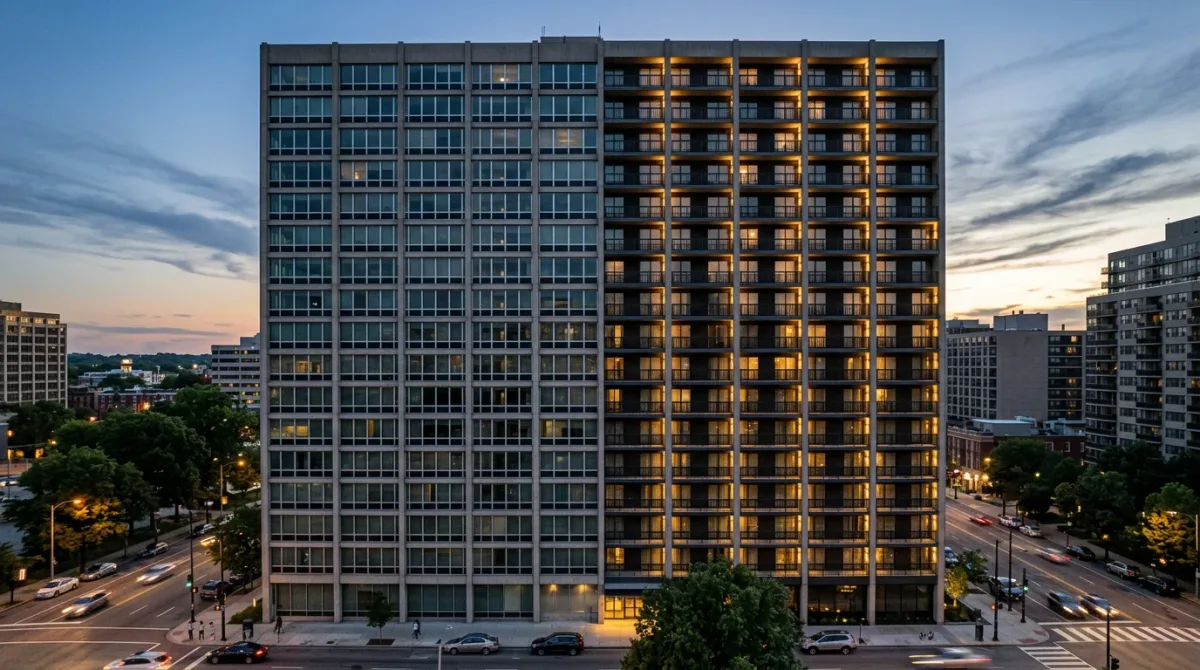
Turning an office building into a hotel takes more than swapping desks for beds — it usually means reworking floor plates, cores, and sometimes the roofline itself. At 509 Madison Avenue in Midtown Manhattan, the owner has proposed adding nine stories and roughly 96 rooms to a 21-story, 1920s office tower, according to a special permit application filed with the New York City Planning Commission.
The filing is a plan, not a finished building — 509 Madison Avenue is still moving through public review, and nothing there has broken ground as a hotel yet. But it's a useful blueprint for how these conversions actually work, and it's happening alongside a much bigger wave: nearly 2 million square feet of Nashville office space is in some stage of becoming hotel rooms, more volume than the city has seen before, according to reporting by The Real Deal.
Why are so many office buildings becoming hotels right now?
The math is mostly about what offices cost to buy versus what it costs to build a hotel from scratch. In Nashville, office buildings have been trading at 20 percent to 40 percent below replacement cost, The Real Deal reports — cheap enough that developers are willing to take on the complications of retrofitting buildings from the 1940s through the 1970s rather than build new. Pandemic-era office vacancies set the wave in motion; stabilizing construction and hospitality pricing more recently has made lenders more willing to underwrite the work.
Financing follows the same logic outside Nashville. In Washington, D.C., an office building at 601 Indiana Avenue NW that had housed local government agency offices sold at a foreclosure auction for $8.5 million in November 2024. Its new owner, Houston-based Dauntless Capital Partners, then landed a $34.4 million construction loan from Artemis Real Estate Partners to convert it into a 122-room hotel, with Calco Hospitality overseeing the conversion, Bisnow reported. Buy low, then spend on the retrofit — that's the pattern showing up in filing after filing. None of it is fast: The Real Deal's reporting notes that due diligence alone on an older office building being weighed for conversion can run anywhere from six months to several years, since engineers have to confirm the structure, plumbing risers, and elevator cores can actually support a hotel's floor plan before a lender signs off.
What actually changes inside the building during a conversion?
Office floors and hotel floors are built for different jobs, and the 509 Madison Avenue plan shows the reshuffling this can require. The applicant's proposal calls for partial demolition starting at the 15th floor, then rebuilding upward to 30 stories with new setbacks — a way of keeping close to the building's existing roughly 139,230 square feet of floor area (about a 20.3 floor-area ratio) while reshaping it into the narrower, corridor-and-window layout a hotel room needs, according to the New York City Planning Commission filing and Commercial Observer's reporting on the plan.
Because the site sits in a C5-3 commercial district inside Manhattan's Special Midtown District, the project also needs a special permit under Section 74-152 of the city's zoning resolution before hotel use — a "transient hotel," in the zoning code's language — is allowed there at all. That approval step, not construction, is where the project currently stands.
Does the old building disappear, or does it stay?
It depends on the project, and the site is worth naming carefully case by case. At 509 Madison Avenue, the developer's plan keeps the base of the 1920s structure — owned by Kensico Properties since 1985, per Commercial Observer — while significantly rebuilding what sits above it. Nothing has been approved or demolished yet.
In Nashville, Dolly Parton's SongTeller Hotel at 211 Commerce Street takes the opposite approach: it's a renovation of an existing building that formerly housed the law firm Baker Donelson's offices, according to the hotel's own press materials, which describe the work as an update to the existing structure — including a new paint scheme — rather than a rebuild. The hotel's own site lists a 2026 opening; it has not yet welcomed guests.
What makes one office building an easier conversion than another?
The three projects above land at different points on the built-to-proposed spectrum, and that distinction matters more than the renderings do.
| Project | Prior use | Plan | Status |
|---|---|---|---|
| 509 Madison Avenue, Manhattan | 21-story office building (1920s) | Rebuild to 30 stories, ~96 rooms | Proposed — special permit pending public review |
| 601 Indiana Avenue NW, Washington, D.C. | Office building for local government agencies | Convert to 122-room hotel | Financed — construction loan closed; plans filed with D.C.'s Department of Buildings |
| 211 Commerce Street, Nashville | Baker Donelson law-firm offices | Renovate into SongTeller Hotel | Under renovation — 2026 opening listed on hotel's site |
None of these has opened as a hotel yet, which is itself the point: even a conversion with a signed loan or a filed permit is still a construction project, subject to the zoning approvals, engineering surprises, and financing conditions that can add months or years before a guest checks in. Reading a conversion announcement, in other words, is not the same as reading a ribbon-cutting — the gap between the two, at every one of these projects, has been measured in years, not months.
Frequently asked questions
Is the 509 Madison Avenue hotel conversion approved yet?
Not as of the filing reviewed here. The project needs a special permit for hotel use in its Midtown commercial district, and Commercial Observer's reporting describes the application as still moving through public review rather than approved.
How many hotel rooms would 509 Madison Avenue get?
The applicant's own filing to the New York City Planning Commission describes a hotel of approximately 96 to 100 rooms inside a rebuilt structure that would rise from 21 to 30 stories.
What was 601 Indiana Avenue NW before it became a hotel project?
It was an office building that had housed local government agency offices in Washington, D.C. Dauntless Capital Partners bought it at a foreclosure auction for $8.5 million before securing financing for a 122-room hotel conversion, according to Bisnow.
Why is Nashville seeing so many office-to-hotel conversions at once?
Nearly 2 million square feet of Nashville office space is being converted, with office buildings trading 20 percent to 40 percent below replacement cost, The Real Deal reports — making conversion cheaper than ground-up construction even with the added complexity of older buildings.
For a related property news perspective, read How a 1970s tax credit is turning old offices into homes.
For more context, read What the Paris–Vienna night train still carries.
For more context, read debbie.
For more context, read ukrainian.