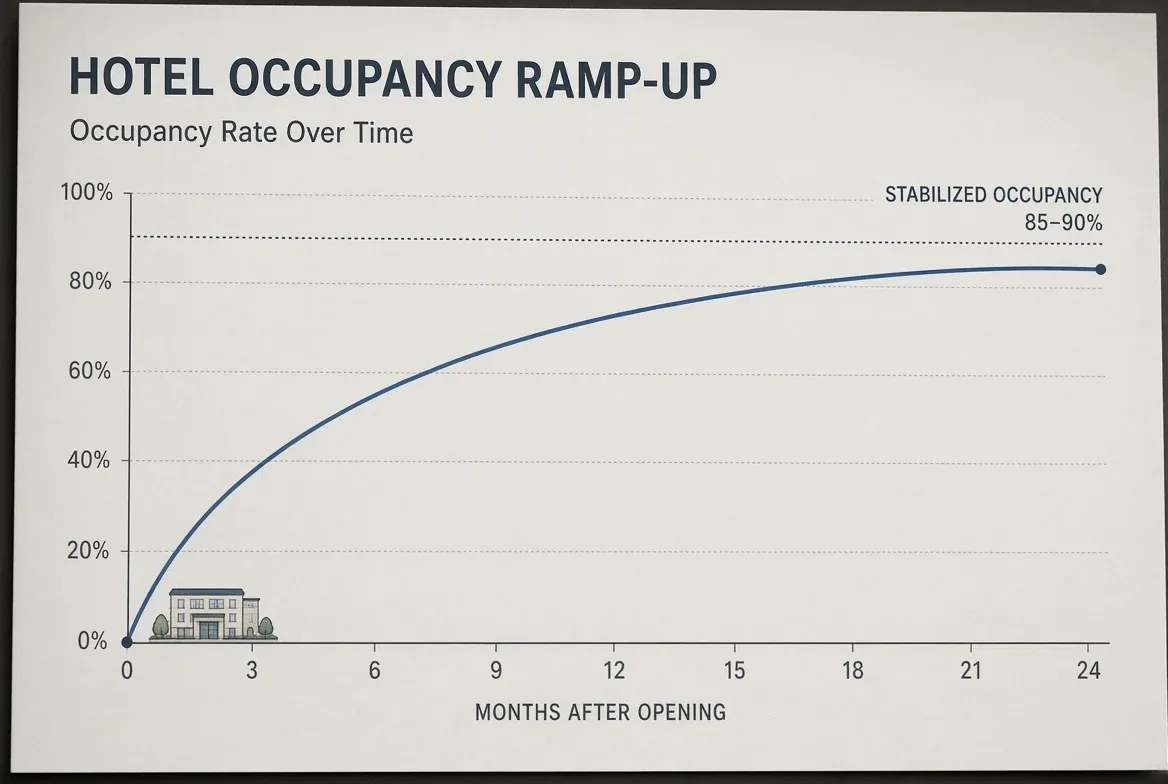
Stabilization is the point at which a new hotel's occupancy and revenue stop climbing off their opening-year base and settle into performance comparable to its established competitive set. New U.S. hotels need about seven quarters, roughly 21 months, to reach occupancy levels comparable to incumbent properties, according to a Cornell Hospitality Quarterly study of 3,494 hotels that opened between 2006 and 2009. For operators and lenders, that window still shapes how a new property is staffed and underwritten.
The study, a Cornell Hospitality Quarterly analysis of 3,494 hotel openings led by researcher Cathy Enz and published in 2014, used an event-study method to track new entrants against their existing competitive sets quarter by quarter. It found that RevPAR, not just occupancy, converges on comparable levels by the second quarter of a hotel's second year of operation on average.
What does "stabilization" mean for a new hotel's P&L?
Stabilization is the quarter when a new property's occupancy and RevPAR stop trending upward from their opening-year base and level off at a run rate comparable to its competitive set. Lenders use it to set the point at which a construction or bridge loan is expected to convert to permanent financing.
Before stabilization, a hotel typically runs below its eventual staffing and revenue baseline. Payroll, however, is harder to ramp gradually than a front-desk count would suggest: housekeeping, engineering, and food and beverage teams are largely sized for a stabilized property from opening day, because service standards and brand audits don't flex downward for a new hotel finding its footing.
That mismatch between early-stage revenue and full-strength cost structure is why the length of the ramp-up period is a financial planning question, not just an operational curiosity. A property that stabilizes in seven quarters carries a materially different pre-opening reserve requirement than one modeled on the traditional three-year assumption still used in some feasibility studies.
How long does it actually take new hotels to reach stabilized occupancy?
On average, seven quarters to occupancy parity and eight quarters to RevPAR parity with the competitive set, per the Cornell Hospitality Quarterly event study of 2006-2009 openings. Brand-affiliated hotels converged faster than independents in the same sample.
The Enz study found new entrants initially priced above their eventual competitive rate, charging average daily rates that exceeded incumbent properties in the opening quarters before adjusting downward as occupancy built. That pattern held across the sample regardless of brand affiliation.
The finding revises an older assumption. A separate Cornell Hospitality Quarterly study, published in 2011 by researcher John O'Neill and covering 3,699 hotels that opened between 2002 and 2008, found the traditional three-year stabilization rule held on average: 3.08 years, with occupancy climbing from about 55% in the first year to roughly 72% by year three. That study also found extended-stay properties stabilized faster, in 2.75 years, than conventional hotels at 3.13 years, and that luxury and upper-upscale properties took longest, at 3.3 years or more.
The two data sets aren't strictly comparable — different samples, different opening years, and occupancy parity is not the same benchmark as full stabilization — but both point to the same operational reality: the first one to three years after opening carry structurally different economics than a stabilized year, and how long that window runs depends heavily on segment and location.
Why do branded hotels stabilize faster than independents?
Brand-affiliated hotels in the Cornell Hospitality Quarterly sample reached comparable RevPAR performance by the first quarter of their second year, faster than the sample average, largely on higher occupancy and lower opening rates than unbranded competitors. Independent hotels took notably longer to close the same gap.
The study attributes the advantage to distribution: brand loyalty programs, central reservation systems, and pre-existing corporate and group accounts give an affiliated hotel bookings on day one that an independent has to build from scratch.
That advantage is part of why soft-brand and collection programs have kept expanding even as new-build pipelines have slowed. Marriott added the Hotel Granada Midtown in Atlanta, a 120-key independently designed property, to its Design Hotels collection in 2025, giving the boutique hotel access to Bonvoy's loyalty and distribution network while keeping its independent identity, Hotel Dive reported. Design Hotels had signed 29 such properties in the prior year alone. Hyatt's Unscripted and JdV brands and Hilton's Curio and Tapestry collections follow the same logic: distribution access without a full brand-standard renovation.
For an operator weighing a soft-brand affiliation against staying independent, the ramp-up data is the argument in dollar terms: faster access to comparable RevPAR means fewer quarters of below-breakeven operation to carry on the balance sheet.
What's riding financially on the ramp-up window?
The capital exposed during ramp-up scales with development cost, which HVS's 2025 U.S. Hotel Development Cost Survey put at a median $219,000 per room across segments, ranging from roughly $167,000 for limited-service to more than $1,057,000 for luxury.
HVS reported construction-cost inflation moderated to 3.32% in 2024 but flagged new tariffs as a source of uncertainty for 2025, alongside elevated financing costs that the survey said have slowed the number of new projects entering the pipeline; the firm forecasts national supply growth of just 0.8% for 2025-2026.
For operators, the math changes at the margin. A slower-growing pipeline means fewer new competitors diluting a market's demand pool, but it also means the properties that do open are carrying higher per-room debt into a ramp-up period that, per the Cornell Hospitality Quarterly research, still runs 1.75 to roughly 3 years depending on segment and brand affiliation.
| Per-room development cost (HVS 2025 survey) | Median cost per room |
|---|---|
| Limited-service | $167,000–$169,000 |
| Midscale extended-stay | $167,000–$169,000 |
| Select-service | $223,000 |
| Upscale extended-stay | $265,000 |
| Full-service | $409,000 |
| Luxury | $1,057,000+ |
FAQ
How long before a new hotel's occupancy matches its competitive set? About seven quarters on average, per the Cornell Hospitality Quarterly study of 2006-2009 openings, with RevPAR parity following roughly a quarter later. Segment and brand affiliation both shift that timeline.
Does brand affiliation guarantee faster stabilization? No, but the same research found brand-affiliated hotels reached RevPAR parity by the first quarter of year two on average, faster than independents, largely through built-in distribution and loyalty bookings.
What's the typical per-room capital at stake during that window? HVS's 2025 survey put the median U.S. hotel development cost at $219,000 per room across segments, with select-service and extended-stay properties generally on the lower end and luxury far above it.
For a related hotels perspective, read Kasa Expands into New Orleans with Takeover of the Historic Lafayette Hotel.
For more context, read More paid vacation didn't fix America's day-off problem.
For more context, read What visitors now pay to spend a day in Venice.
For more context, read What it takes for a place to earn a World Heritage listing.