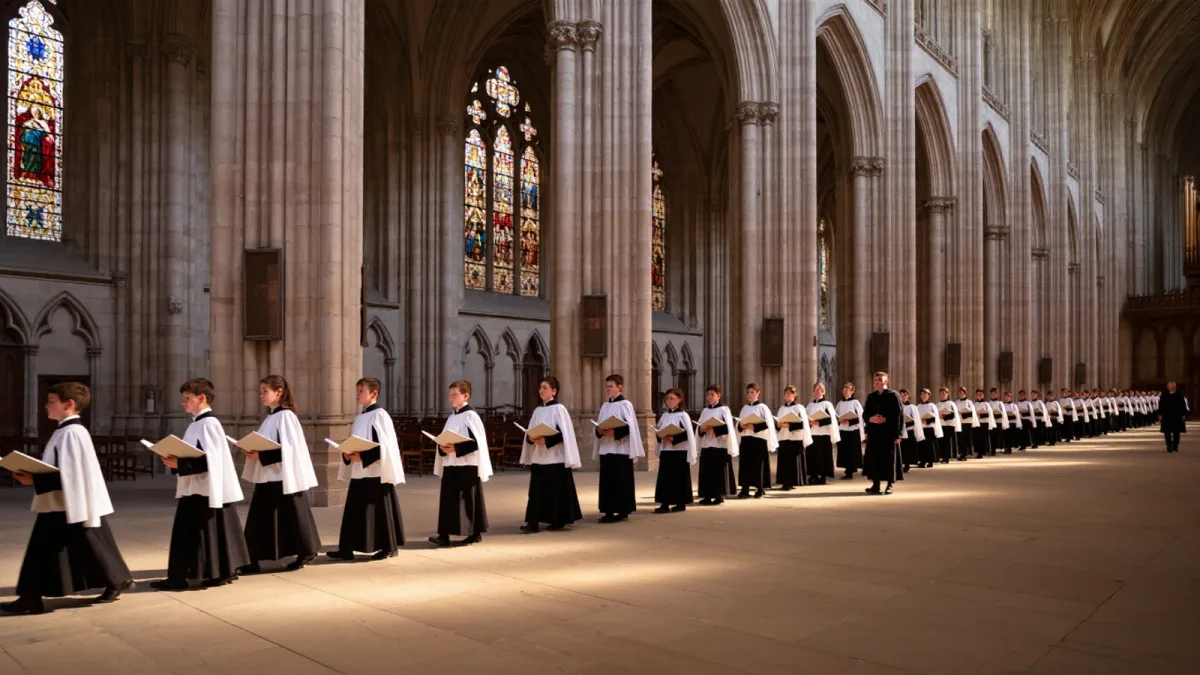
The choristers of England's cathedrals are working children with a seven-hundred-year job description: sing the daily offices, learn the repertory of English church music, and hold the acoustic of a medieval building to a professional standard, every day of term. The tradition survived the Reformation that emptied the monasteries, and its most famous product, the Festival of Nine Lessons and Carols at King's College, Cambridge, first sung in 1918 and broadcast by the BBC since 1928, carries the sound to millions once a year. Every afternoon of term, though, in some forty-odd cathedrals, the less famous work happens as it always has: children in cassocks process, the organ gives the note, and evensong is sung because it is sung, whether anyone comes to hear or not.
What does a chorister's working life look like?
Like a small professional's. Choristers are engaged, usually between ages eight and thirteen, auditioned, trained daily in musicianship, and rehearsed before and after the school day; they sing multiple services a week, learn a repertory that spans Tudor polyphony, Victorian anthems, and new commissions, and are paid, modestly, as the tradition has always paid its children, a fact recorded in cathedral accounts back to the Middle Ages. The day runs on the buildings' own clock: rehearsal, school, evensong, and out, with the great services, Easter, ordinations, the carol season, layered on top.
The training is vocal and civic at once. Choristers learn to read at sight, to blend by ear rather than by instruction, and to carry the professional discipline of someone on whom a service depends; former choristers describe the apprenticeship in exactly those terms. The repertory's demands are real: the English cathedral service is one of the few musical institutions that commissions and premieres new work every season, performed by children, on schedule.
How old is the arrangement?
Older than the buildings. Cathedral song schools existed in England before the Norman Conquest, and the medieval foundations' accounts, stipends for the boys, wages for the men, provisions for their schooling, established the pattern that the Reformation's new statutes then regularized rather than abolished: the cathedrals of the new church kept choirs, laid out in documents from the sixteenth century onward that are recognizably the same job. The repertory changed with every century, and the vestments did, and the boys kept coming.
The tradition's modern chapter includes its biggest structural change in five centuries: the admission of girls. Salisbury Cathedral founded the first cathedral girls' choir in 1991, and since then most English cathedrals have followed with parallel girls' foundations, so that the daily offices are now sung by both, on alternating schedules or together. The change is documented in every cathedral's own records, and the chorister schools' applications suggest the tradition has widened rather than thinned.
What can a traveler actually attend?
A service, which is free and open. Evensong at an English cathedral is a public act of worship, not a concert; visitors walk in, sit in the nave, and receive the music in the building and arrangement it was written for, with the choir processing past them at both ends. The etiquette is the church's: quiet before the service, no flash photography, and no applause afterward, since the choir's employers regard the service as offered rather than performed. Choral foundations publish their service schedules, and most cathedrals hold open rehearsals, tours of the song school, and, for families, chorister open days where the audition's reality is demonstrated rather than explained.
The annual exception, King's at Christmas, deserves its fame and its terms: the Nine Lessons and Carols service is ticketed by ballot for the public, the broadcast carries it worldwide on the morning of Christmas Eve, and the descant on the final hymn is the tradition's audible summit. Hearing it in the chapel requires either the ballot or the queue; hearing the same craft at a county cathedral on a Tuesday in February requires only attendance.
The repertory's depth is the tradition's curriculum. A working chorister in a single year will sing Tallis and Byrd from the Reformation's turbulence, Purcell and Blow from the Restoration, Stanford and Howells from the Victorian and twentieth-century efflorescence, and the season's new commission by a living composer, all from memory-grade familiarity rather than concert preparation; the sense in which English church music constitutes a continuous vernacular, passed mouth to mouth at the daily services, is not a metaphor but the repertory's transmission history. The choirs' recordings and the broadcast services carry it outward, and the annual carol season, when even the smallest foundations sing to full pews, functions as the tradition's open house, attended by families who will spend the rest of the year not realizing that the same forty minutes of music happened every afternoon they walked past the west front.
Why does a daily child choir still make sense?
Because nothing else produces the sound or the people. The boys' and girls' treble voice, trained daily in a resonant stone room, remains the instrument the English repertory was written for, and the choristership remains one of the country's most proven musical apprenticeships, sending its alumni into the profession and, in larger numbers, into lay careers with the habit of excellence installed early. The cathedrals keep the tradition for liturgical reasons, the services must be sung, and the children, families, and foundations keep it for reasons they state consistently: the work is real, the building is vast, and a twelve-year-old who can hold a line at the top of a psalm in that acoustic has done something no adult room forgets.