Murano's furnaces have burned, with interruptions of war alone, since 1291, when Venice's Great Council ordered the glassmakers' fires out of the crowded city and onto the island in the lagoon, whose distance protected Venice from a conflagration without exiling the craft. The decree began the longest continuous glassmaking tradition in the Western world: a guild with its own statutes, dynasties of masters whose names, Barovier, Seguso, Toso, still sign the work, and a set of Republic-era rules so protective that glassmakers lived under privileges and pressures recorded in the archives. A traveler who visits Murano today is watching the direct continuation of that system, and the island repays knowing what one is looking at.
Why did Venice quarantine its glassmakers?
For fire, and then for control. The 1291 relocation answered the obvious danger of furnace cities built of wood, but the Republic's subsequent policy was industrial strategy: the Arte dei Vetrai, the glassmakers' guild, received privileges that read like a state sponsorship package, including the documented right, remarkable for its time, for the daughters of masters to marry into the Venetian nobility without forfeiting status. The other side of the bargain was secrecy: the Republic restricted the movement of master glassmakers, who lived under real legal pressure not to export their skills, though the lurid story of a standard death penalty for emigration is not well supported by the archival record and is best treated as legend growing around a genuine, documented policy of restraint.
The policy worked for centuries. Venetian cristallo, the fine clear glass perfected in the fifteenth century, notably by Angelo Barovier's workshop, dominated European luxury markets, and mirrored glass, enamel, and the island's signature colored cane work carried the word Murano into languages as a synonym for fine glass, a brand the island still owns.
What is the craft actually like to watch?
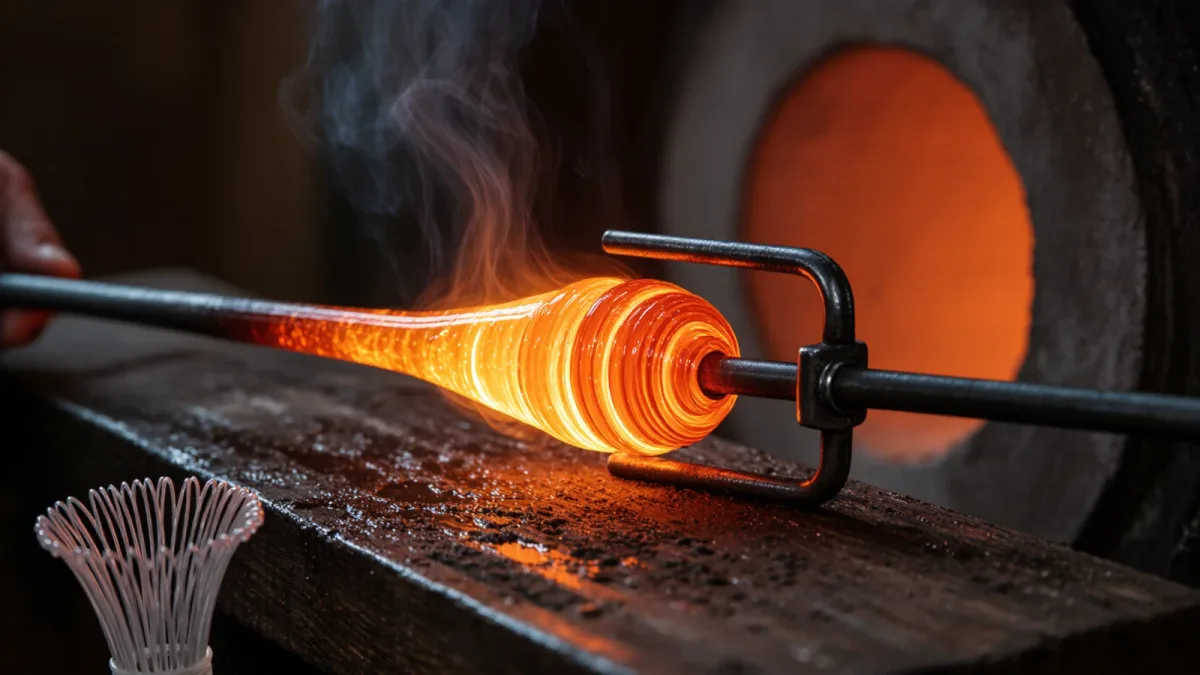
Loud, fast, and collective. A Murano furnace team works in a hot shop organized around the glowing gather: the master takes a mass of molten glass on the pipe, and the assembly of glassblower, assistants, and special-skills workers turns, inflates, and models it with poles, paddles, and shears, at a speed that makes the finished object's elegance look like sleight of hand. The island's special techniques, filigrana's white canes twisted through clear glass, murrine's patterned mosaic slices, the gold leaf sealed inside a cased vessel, all resolve into visible form in seconds at the bench, which is why watching is the essential part of any visit.
The division of labor is the guild's inheritance. Murano's furnace work is team work under a master, the design tradition runs through family botegas alongside the island's design school, and the signature on a finished piece covers a chain of named specialists rather than a lone genius. Collectors who understand this read the island's prices correctly: the master's name prices the team's coordination, centuries of technique, and the material's provenance, not merely hours.
The island's material culture records the trade's self-image in glass. The church of Santa Maria e San Donato keeps its twelfth-century pavement and the basilica's relics; the Museo del Vetro, in the palazzo of the Bishops of Torcello, traces the craft from Roman vessels to the present with the Republic's statutes on display; and the campi carry the plaques of families whose workshops have run for generations on the same lanes. Murano is small enough to walk end to end in half an hour, which makes its depth disproportionately strange: a visitor crosses one bridge between a furnace where a team is pulling cane and a museum case where the same technique appears in a piece blown three centuries before the Republic ended. Nothing on the island explains this by accident. It is the point of the place, kept deliberately within walking distance of itself.
How should a visitor buy and behave?
Insist on the real thing and respect the furnace room. Genuine Murano glass is made on the island by its makers, and the reputable botegas certify origin; the harbor of mass-produced imports sold as Venetian in the city's tourist stalls is the trade's documented affliction, and the price and the paperwork distinguish them. Watching a demonstration is part of the island's hospitality, but a furnace room is a working factory floor, so visitors follow the ropes, keep cameras from the workers' faces, and remember that a demonstration is skilled labor, not a street performance; the botegas that charge nothing for it earn the purchase.
Questions are welcome in Murano in a way they are not everywhere. The masters' culture, shaped by decades of museum retrospectives and international collaborations, treats explanation as part of the craft, and a visitor who asks how the canes are made or why the piece must cool for days in the annealing oven will get a technical answer, in several languages, often with the pipe still warm.
Can the tradition survive the pressures it faces?
It is surviving them the way it survived the Republic's fall: by adaptation at family scale. Cheap imports, mass tourism's eras, and the lagoon's environmental troubles have all hit the island hard, furnace numbers fell across recent decades, and the trade's answer has been to consolidate around the historic botegas, train new masters through the island's school, and lean on the one asset nobody can copy, seven centuries of continuous technique in one small place. The furnaces that the Great Council ordered lit in 1291 are still lit. That fact, more than any object, is what the island sells, and so far it has kept the buyers.