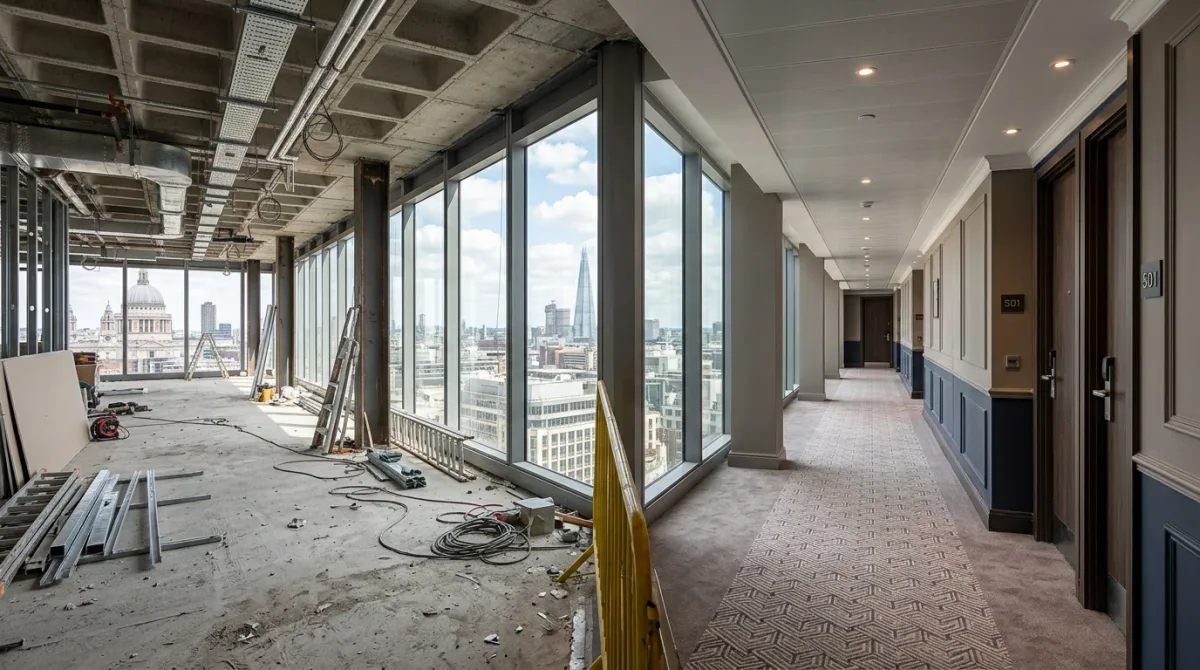
Adaptive reuse is the conversion of an existing building to a new purpose instead of demolition and new construction. Turning a vacant office tower into hotel rooms costs $250 to $650 per square foot, according to CBRE — a range that can undercut ground-up hotel development, but only when a building's structure and permitting path cooperate.
For operators eyeing a market with empty office stock nearby, the number that matters isn't the range. It's where a specific building falls inside it.
How much does converting an office into a hotel actually cost?
CBRE's April 2024 analysis of the U.S. office-conversion pipeline puts the cost of turning a typical vacant office building into another use at $250 to $650 per square foot. The brief doesn't break out hotel-specific projects from the wider pipeline, but Hotel Dive, citing the same CBRE range, ran the math against a 200,000-square-foot office converting into a 260-room hotel: about $50 million at the low end and roughly $130 million at the high end.
Spread across 260 keys, that works out to roughly $192,000 to $500,000 per room — before furnishings, brand fees or the plumbing and structural work a former office floor typically needs before it can hold guest bathrooms.
How does that compare with building a hotel from the ground up?
Ground-up development is the benchmark conversion has to beat. JLL data reported by Hotel Dive puts the average cost of building an urban full-service hotel from scratch at $742,000 per key in 2023, up 32% from 2019. At that rate, a 260-key hotel runs close to $192 million before land costs.
Set against the same 260-key example, conversion comes in roughly one-third to three-quarters cheaper per key than new construction, depending on where a given building lands in CBRE's cost range.
| Development path | Cost basis | Per-key cost (260-key example) |
|---|---|---|
| Ground-up construction | $742,000/key, JLL, 2023 (+32% vs. 2019) | $742,000 |
| Office conversion, low end | $250/sq. ft. on 200,000 sq. ft. | ~$192,000 |
| Office conversion, high end | $650/sq. ft. on 200,000 sq. ft. | ~$500,000 |
Why is so much office space becoming available for this right now?
Vacancy is the supply side of the equation. CBRE's 2024 market outlook, published in December 2023, forecast that national office vacancy would peak near 19.8% by the end of that year. A separate CBRE brief measured vacancy at 18.6% as of the fourth quarter of 2023, with eight of the ten most active conversion markets running above the national average. Nearly 70 million square feet of U.S. office space — 1.7% of total supply — was undergoing or planned for conversion as of the first quarter of 2024, CBRE found, up from 60 million square feet a quarter earlier. The firm counted roughly 120 office-conversion projects nationwide expected to finish in 2024, against an annual average of 45 between 2016 and 2023.
Most of that converted space is still becoming apartments, not hotel rooms. CBRE's brief put office-to-multifamily conversions at 63% of the pipeline it tracked, with hotel projects folded into a smaller mixed-use share. RentCafe, the Yardi-owned rental research group, reported in March 2026 that office-to-apartment conversions alone reached 90,300 units in the national pipeline, up 28% year-over-year and nearly four times the 23,100-unit total in 2022. In RentCafe's separate tracking of which building types are being converted into apartments, hotels supplied 18% of the source buildings, behind offices at 47% — a different data set from office-to-hotel activity, but a sign of how much reuse volume residential developers are absorbing.
For hotel operators, that split matters: most of the office glut is being bid on by apartment developers, which narrows the buildings actually competing for conversion into guest rooms.
What actually breaks the math on an office-to-hotel conversion?
Plumbing is the recurring problem. "Offices just weren't designed to have a bathroom every 200 square feet," Andrew Hartley, a director on CBRE's Hotels Valuation and Advisory team, told Hotel Dive. Adding a bathroom to nearly every guest room means routing new risers through a structure that was never built for that density of wet walls.
Column grids compound it. Jack Paruta, Gensler's hospitality leader, described fitting hotel room layouts into an office building's existing columns and structural core as "like a puzzle" in comments reported by Hotel Dive. Back-of-house needs — separate staff corridors, loading docks, a guest drop-off at the entrance — often have no equivalent in an office building's original design and have to be built in.
Those retrofits add up. "Historical adaptive reuse [has] almost always [been] much more costly than ground-up development, mainly because you have to maintain certain standards," Hartley told Hotel Dive. "There's a lot of unforeseen contingencies and costs that you have to adapt for." That view, from the same CBRE team that supplies the industry's conversion-cost range, tempers the read that a $250-per-square-foot project is simply going to work.
The conversions that have gotten built anyway show what clears that bar. Aspen Hospitality and Tishman Speyer are converting office space at Rockefeller Center into a 130-room hotel, Hotel Dive reported. Marriott's Autograph Collection added the Watermark Baton Rouge from a former office building, while Mint House opened extended-stay units in a converted office at 1010 Vermont Avenue in Washington, D.C. The Kimpton Gray Hotel in Chicago, also an office conversion, drew about $10 million in historic tax credits, Hotel Dive reported — the kind of subsidy that can move a conversion from marginal to viable. Hotel Marcel in New Haven, Connecticut, converted from a Brutalist former office building, is what Hotel Dive reported as the first Passive House-certified hotel in the U.S.
Dan Peek, president of JLL's Hotels & Hospitality Group Americas, described office-to-hotel conversion to Hotel Dive as "first and foremost an urban trend" — tied to the downtown vacancy that CBRE has tracked climbing since 2019. Gensler's Lori Mukoyama, the firm's global hospitality leader and design director, framed the appeal in guest terms rather than cost terms: "The largest trend in hospitality is that people want authentic spaces," she told Hotel Dive.
For an operator underwriting one of these deals, both are true at once. The per-key numbers can beat ground-up construction by a wide margin — and the same building's plumbing, columns and loading dock can erase that margin before the ribbon-cutting.
For a related design perspective, read Office-to-hotel conversion: what the cost data actually shows.
For more context, read How an office tower turns into a hotel, floor by floor.
For more context, read What the Paris–Vienna night train still carries.
For more context, read The Most Expensive reality show bids farewell to Marbella.