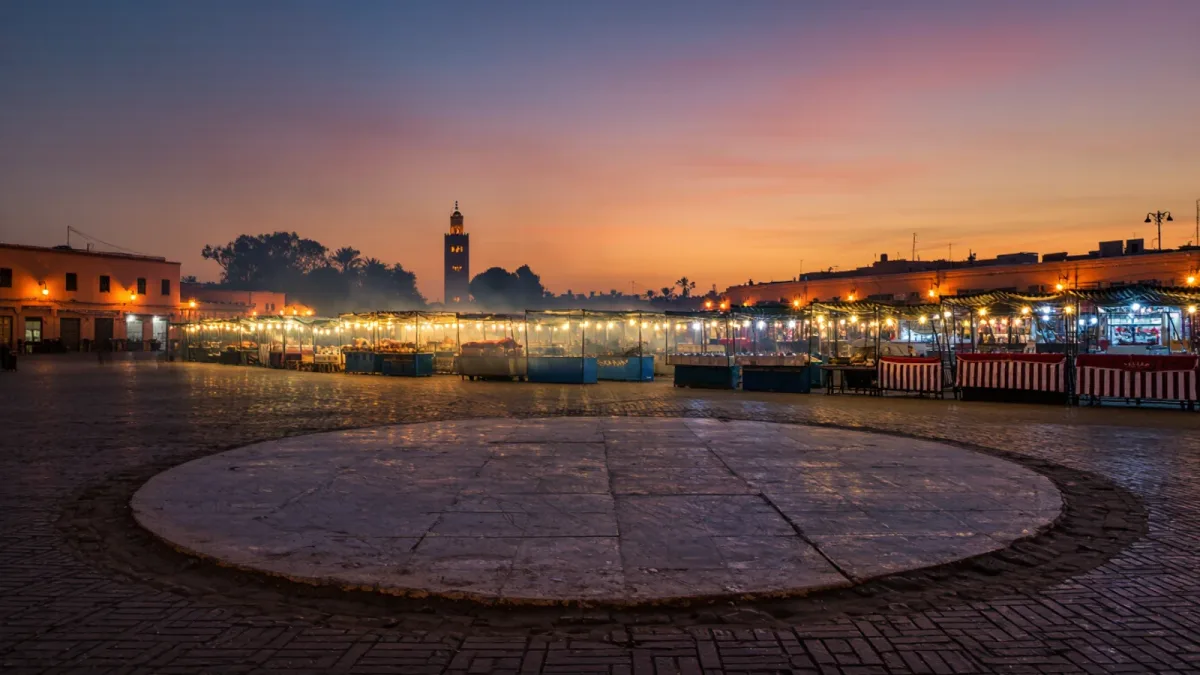
The halqa of Jemaa el-Fna is a performance with no stage and no boundary: a storyteller, a drum, or a charmed snake begins, and the audience forms a circle around the artist with its bodies, dense, breathing, and mobile, opening to let newcomers in and closing when the tale tightens. The great square at the heart of Marrakech has hosted this form for centuries, and in 2001 it received a distinctive international recognition as a masterpiece of oral heritage, the first of its kind, in explicit homage to the square's tellers, musicians, and crowds. The halqa is the tradition's whole architecture: whoever stands in it belongs to it, and the circle's edge is simply where the next stranger stops.
What is a halqa and how does it work?
It is a theater made of attention. The performer, a halaiqi, takes the center and begins with the cry or catchphrase that gathers a crowd; the circle forms within minutes and must be held, which is why the traditional repertory runs on suspense, from the epic sira literature and the trickster tales of the medina to jokes, riddles, and moral fables with their endings deliberately suspended at the moment a hat is passed. The hat, or the upturned cap, is the form's economy: listeners pay at the pause, and the teller's craft is measured by how many stay to the pause and pay twice.
The circle's etiquette is the audience's art. Regulars stand their ground, answer the teller's calls, and shush the tourists; the front rows squat for the length of the tale; and the competition between circles on a busy night is conducted in volume, drumroll, and crowd height. Ethnographers of the square, Moroccan and foreign, have documented all of this in detail, and they agree on the form's essential skill: holding strangers together for the length of a story, night after night, for pay that is never certain.
The square's own archive shows how deep the form runs. Marrakech was founded in the eleventh century as an Almoravid capital, and travelers' accounts from later centuries describe the square's assemblies of performers, preachers, dentists, and animal handlers in terms a modern visitor would recognize; Moroccan chroniclers treated Jemaa el-Fna as the city's theater long before anyone called it heritage. The storytellers' repertory preserves that depth: the sira epics recounting the Prophet's kin and the great battles, the imported tricks of the trickster, and the local satires of the day's news form a layered canon, transmitted by apprenticeship in the circle rather than by any school.
What else performs on the square?
The full repertory of Moroccan street arts, organized by territory. Storytellers and reciters hold the center; Gnaoua musicians with their metal qraqeb castanets and long lutes play their trance-adjacent repertory; the chikhat perform song; snake charmers work the daytime edges, to the documented discomfort of animal-welfare observers; henna artists, water sellers in their tasseled hats, and the orange-juice and food stalls that rise each evening fill the square's commercial layer. The food stalls' number, climbing to dozens under lights each dusk, has its own governance, with the grill masters calling menus in a barker's cadence that locals regard as part of the square's music.
The square's evenings are seasonal only in temperature. Ramadan reorders the nights entirely, the circle crowds return with the post-fast hours, and the storytellers' repertory adjusts to the religious calendar, since the tradition has always absorbed religious recitation, the Qur'anic chanters and the maddah, alongside the profane tales.
What should a visitor know before entering a circle?
That the hat is the point and the pause is the contract. A visitor who joins a halqa should expect to stay for a stretch of the tale and to contribute when the cap comes around, an amount within local norms, not the tourist's reflex of either nothing or too much; listening at the edge and vanishing at the collection is the documented grievance of the square's professionals. Photographing a performer without asking is the second grievance, and the halaiqi's day rate depends on the crowd's goodwill, so the respectful visitor asks, pays small, and listens.
Language is not the barrier people fear. The tales run in Moroccan darija and Arabic, with some Berber and French, and a listener who understands none of it can still follow the performance's architecture, the rise, the suspense, the chorus of the circle. The square has always been multilingual; Marrakech sat on routes where the audience was never uniform, and the tellers manage comprehension with repetition, gesture, and the drum.
The form's economic fragility is the conservation conversation's honest core. A halaiqi earns by the evening, in small coins, against rents and the competition of recorded music, and the tellers' association that formed after the 2001 recognition has worked on pensions, health coverage, and the training of successors. What visitors spend in the circles is, in the plainest sense, the tradition's income; the hat is not a folkloric decoration but the entire business model, and the square's continuing nightly performance is funded one small bill at a time by the people who stayed to the end of the story.
Can the tradition hold against screens?
It has held, with visible strain. The square's recognition in 2001 brought conservation attention, and Moroccan cultural institutions have since documented the repertories, supported the tellers' association, and nurtured a new generation of halaiqi, including women who have entered the circles in recent years, a change the square's own regulars describe as the tradition's renewal rather than its break. The pressures are real: development around the square, tourism's taste for spectacle over narrative, and the ordinary economics of an art paid by the hat. But the form's genius is that it requires nothing but a person, a crowd, and a dusk, all of which Marrakech still supplies nightly, in circles that close and open all evening like breathing.