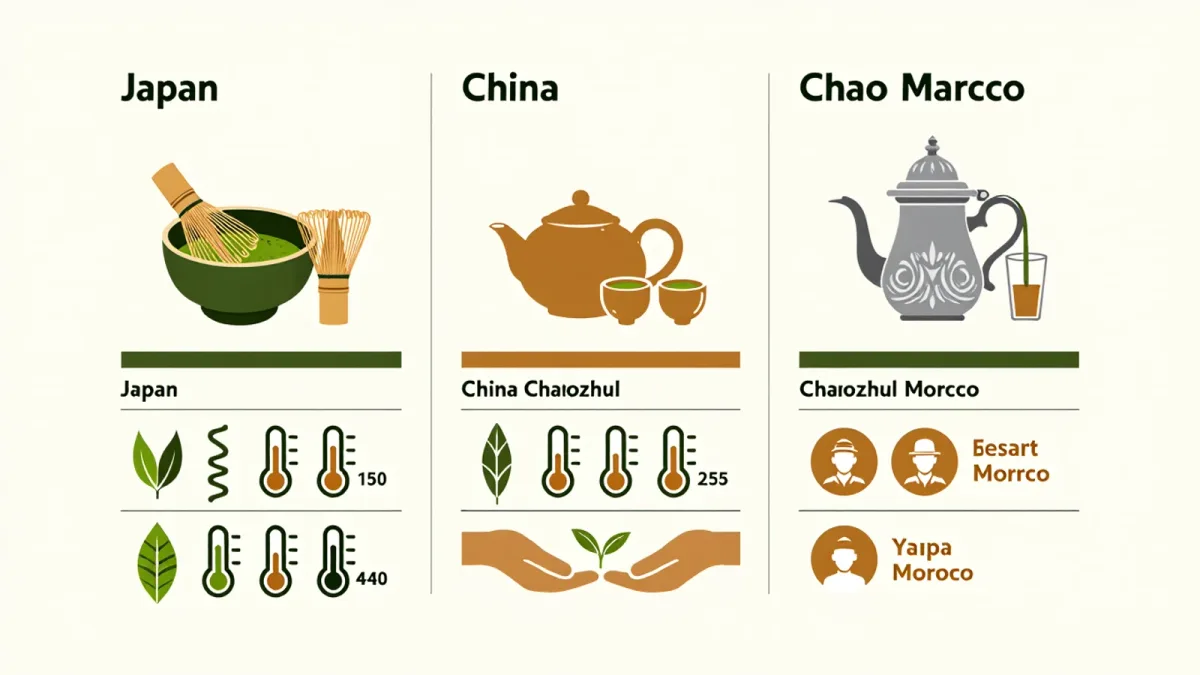
Tea becomes ceremony wherever someone decides the serving is the meaning. The leaf is the same plant, Camellia sinensis, but the great tea cultures built three distinct technologies of welcome: the Japanese chanoyu, codified in the sixteenth century by Sen no Rikyu, who turned a farmer's bowl of whisked tea into an aesthetic discipline; the gongfu cha of China's Chaozhou region, which treats brewing as a skill so fine that the same leaves yield a dozen successive pots; and the mint tea of Morocco, poured from a height into small glasses, whose refusal is nearly impossible because it is not a drink but the household's honor. A traveler who learns what each ceremony asks walks into all three as a guest rather than a spectator.
What does the Japanese tea ceremony actually require?
Attention, arranged. Chanoyu as Rikyu and his successors shaped it is a choreographed gathering in a dedicated room or hut: the guests pass through a garden path that separates them from the ordinary world, admire the scroll and the single flower arranged for that day, and receive a bowl of matcha whisked before them, each object and movement prescribed but expected to feel inevitable. The aesthetic is wabi, the beauty of the austere and slightly imperfect, and the historical record of Rikyu, who served the ruler Toyotomi Hideyoshi and died by his ordered suicide in 1591, is a documented reminder that this art was once politics at the highest level.
The ceremony's etiquette is learnable in essentials: bow at the specified points, turn the bowl before drinking, admire the utensils when invited to, and accept that the gathering's tempo belongs to the host. Formal study takes years; a respectful first attendance, offered at cultural institutions and tea schools in Kyoto and beyond, takes an afternoon.
How does Chinese gongfu brewing differ?
By maximizing the tea instead of the setting. Gongfu cha, rooted in the Chaozhou and Fujian tea cultures, brews a large proportion of leaf in a small vessel for seconds rather than minutes, then pours for a table of small cups, repeating through many infusions in which the leaves' character unfolds and fades. The ceremony's center is the palate: serious tables discuss the water, the pour, and the successive rounds with the vocabulary of tasting, and the famous Chaozhou style holds that the craft exists to do justice to oolongs and aged teas that a Western-style long steep would ruin.
The etiquette is hospitable rather than formal. The host fills cups in order, the guest receives with two fingers, and in the classic tap the table to thank the pourer, a gesture with its own recorded folk origin story. Nobody performs; the table's whole art is a conversation about the leaf, and visitors who are honest about what they taste are received as participants.
The objects carry the doctrines, which is why the three tables look nothing alike. A chanoyu gathering uses perhaps a dozen utensils, each chosen for the day, the season, and the guests, and connoisseurship of those objects, the caddy, the bowl, the scroll, became one of Japan's great collecting traditions; the record of which bowls Rikyu owned and used is itself a documented art-historical literature. The gongfu table needs only its pot, cups, and a tray for the spent water, but its aesthetics are perfectionist about clay and glaze, since porous Yixing pots season with use and are devoted to a single tea type for life. The Moroccan service is silver metalwork and glass, portable and showy, built for a ceremony that travels to the guest rather than the reverse.
What are the rules of Moroccan mint tea?
Generosity first, and the pour from a height. Moroccan tea is gunpowder green tea, fresh spearmint, and a striking amount of sugar, brewed in a metal teapot and poured into small glasses from above so the tea foams; the first glass traditionally returns to the pot to mix the brew, and the host pours the second and third for the guests. The serving is the hospitality itself, offered to whoever enters, at any hour, and the traveler should understand that declining is socially difficult: the glass is the welcome, the house's standing, and the region's shared custom in one gesture.
The history explains the sweetness. Green tea reached Morocco in quantity through trade with Europe in the eighteenth and nineteenth centuries, and the mint-and-sugar preparation turned an imported leaf into a national institution, served in the Atlas villages and the medina salons alike. The ceremony's etiquette is the simplest of the three and the hardest to refuse.
What the three share is the deliberate slowness that no practical drink requires. Brewing tea badly takes two minutes; each of these traditions spends twenty to two hundred on the same chemistry, and the surplus time is the content: training attention in one case, training the palate in another, and declaring the household's openness in the third. Sociologists of hospitality could hardly design a better comparative set, and travelers who experience all three, in Uji, in Chaozhou, and in a Fes courtyard, tend to report the same conclusion from different directions, that being served well is a skill cultures spend centuries learning, and that the lesson transfers.
What does a respectful guest do differently in each?
In Japan, follow the host's choreography and slow down; the ceremony is a made environment, and the guest's gift is attention. In Chaozhou, taste honestly and let the table teach; the guest's gift is participation. In Morocco, accept the glass and stay a while; the guest's gift is presence, and the refusal, however polite, costs the host more than the tea. Three ceremonies, one instruction in the end: the leaf is never the point, the people pouring it are, and each tradition found its own way to say so.