
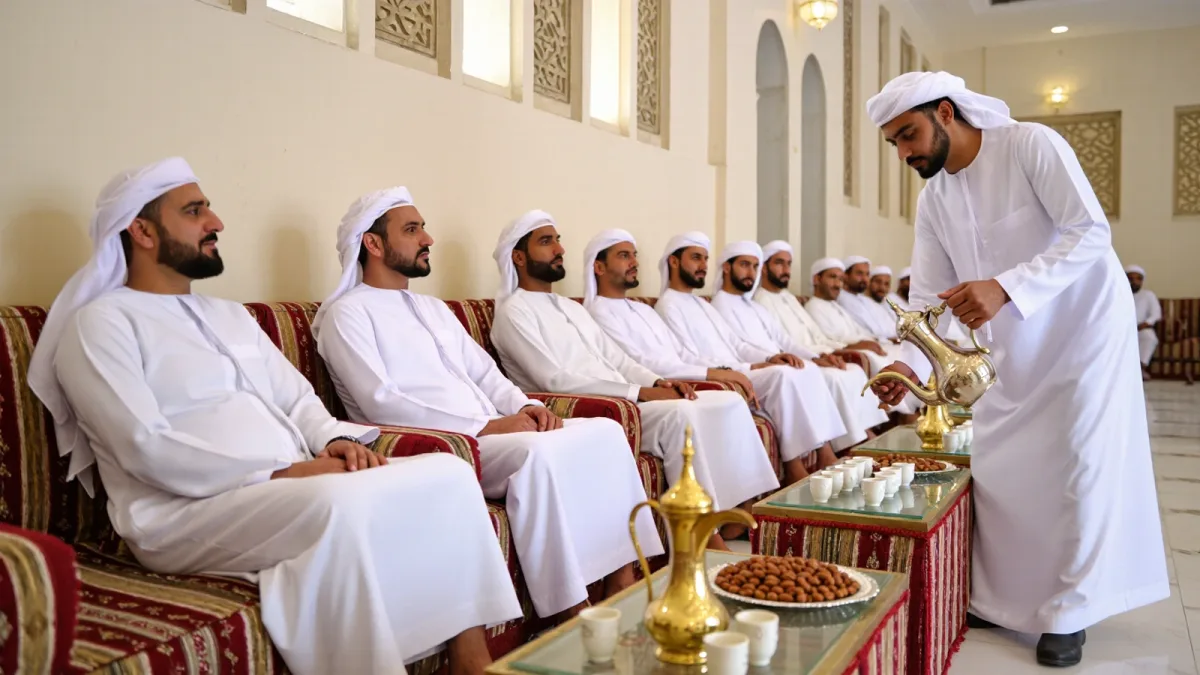
The diwaniya is the room where Kuwait does its talking: a reception hall attached to a family's house, kept open on specified evenings, where guests arrive without appointment, take coffee and dates, and settle into the evening's business, which runs from condolences and wedding planning to the week's politics. The institution descends from the majlis, the Arabian Peninsula's traditional sitting of host and guests, a practice the region's states saw recognized internationally as living heritage in 2015, and in Kuwait it remains a living fixture: members of parliament hold diwaniyas as a matter of course, and the country's political life has long been conducted partly in these rooms.
What is a diwaniya exactly?
A room, a schedule, and a social contract. Architecturally, the diwaniya is a large reception space with its own entrance, deliberately separate from the family's private quarters, often built or reserved so that guests never disturb the household. Its keeper, the diwaniya's host, sets the evenings it receives, traditionally several nights a week; guests arrive in flowing waves, are served the small glass of bitter cardamom coffee and the dates that open every sitting, and take seats in an order that mixes seniority with ease. There is no invitation list. A man of the town who has business or conversation with the host, or simply wants the room, comes and is received.
The diwaniya's division of labor follows the majlis's old logic: the host guarantees welcome and protection, the guests bring news, judgment, and society. Hospitality is the fixed cost of the institution, whoever comes is fed and served, and the standing joke in Kuwaiti commentary, that a popular diwaniya can eat a family's budget, records the obligation accurately.
The diwaniya's history tracks the town's own. In the pearling and trading Kuwait of the nineteenth century, the merchant families' diwaniyas doubled as commercial offices, where dhow owners met captains, prices were struck, and the town's affairs were argued out; the ruling family maintained its own reception salons in the same idiom. The oil decades rebuilt the city around the old social hardware rather than replacing it, and Kuwaiti urbanists have noted that new districts fill with houses whose diwaniyas face the street precisely because the room, not the house, is the unit of public life. Political history runs through the same rooms: the reform debates of the early twentieth century and the constitutional movement found their audiences in diwaniyas, a fact the country's historians treat as continuity rather than coincidence.
Related stories: What Finnish sauna etiquette asks of a guest · The circle in the square at Marrakech.
How political is the diwaniya really?
Constitutionally, in effect. Kuwait's parliament is the most assertive elected body in the Gulf, and its representatives have treated the diwaniya as their permanent town hall for decades, campaigning house to house through the evenings before elections and holding regular sessions where constituents raise grievances face to face. The country's women won the vote in 2005, and female candidates and voters entered the diwaniya circuit, transforming an institution that had been a men's space by default; women now hold their own diwaniyas as well, a development covered extensively in Kuwaiti press. International observers of Kuwaiti politics, from scholars to visiting journalists, routinely describe the diwaniya network as the country's real connective tissue between elections.
The room handles the rest of life with the same seriousness. Diwaniyas are convened for condolence receptions in the mourning tradition, for wedding celebrations, for family alliances, and for the professional guilds, artists, footballers, merchants, who maintain institutional diwaniyas of their own. The same furniture and the same coffee carry all of it, and the guest's skill is reading which evening is which.
Can a traveler attend?
By introduction, and increasingly by open door. Some prominent diwaniyas, particularly political and cultural ones, welcome foreign visitors who arrive respectfully or come with an introduction, and a guest introduced by any member of the room is received as the member's own. The etiquette is the majlis's: arrive after evening prayer in modest dress, take the coffee when offered and return the glass, greet the host and the seniors first, and let the room's conversation set yours. Questions about the host's family are warm; interrogation about anyone's private life is not, and politics is discussed in Kuwait with a directness that can startle visitors, but a guest does well to listen more than argue.
The coffee deserves attention as the institution's language. The pour is small by design, the pot is refilled without asking, and the guest signals completion by shaking the cup gently; the serving is an ongoing courtesy rather than a course. Nothing in the room is rushed, and the evening's natural end arrives when the guests stand one by one and take their leave of the host, the oldest exit protocol in the Peninsula.
The coffee service itself carries the room's oldest signals. The dallah, the beaked coffee pot, is poured with the right hand, the glass held in the left, and the first cup goes to the most honored guest; the amount poured is deliberately small, both from the Bedouin arithmetic of scarcity and to keep the servant moving, since a room of twenty guests is served in rotation for the whole evening. Cardamom, sometimes with a trace of saffron, perfumes the beans roasted lightly rather than darkly, a Gulf style distinct from the Ottoman coffee most visitors know. A guest who praises the coffee correctly, as the room's blessing rather than a beverage, has understood the diwaniya's premise, that welcome is the institution and everything else is its agenda.
Why has the diwaniya lasted when so much else changed?
Because it solves problems the modern city still has. Kuwait's transformation from pearling town to oil state compressed a society into a metropolis within a lifetime, and the diwaniya scaled with it, giving the new city neighborhoods a standing place where strangers become acquaintances and acquaintances become faction, faction in the older sense of people who owe each other presence. The room asks little: an evening, a pot of coffee, an open door, and constancy. As sociological machinery goes, it is among the least expensive and most durable in the region, and it is running most nights, in most districts, while the city sleeps late.