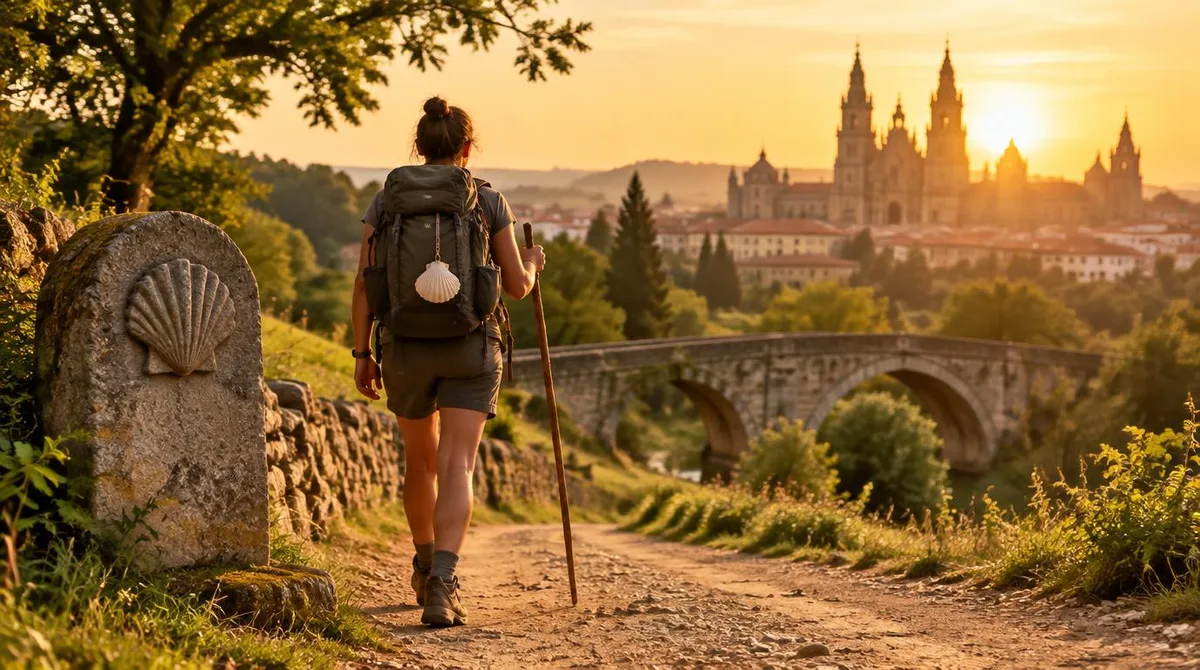
Why do so many walking routes in Europe and the Middle East lead to shrines, cathedrals, and desert monasteries? Because the stories of the bible gave people destinations long before guidebooks existed. A pilgrimage was, at its simplest, a journey toward a place where a story was believed to have happened. The route grew around the story, and the story kept the route alive.
That pattern still holds. Modern walkers set out on the same logic, whether they carry a faith, a curiosity, or just a pair of boots. The trail is the same corridor it was centuries ago, but what travelers bring with them has changed shape. A paper psalter has become a phone. A Latin lesson has become a translation app. The walking has not changed much at all.
How did a story turn into a route?
A pilgrimage route begins as a repeated act. Someone walks to a place tied to a narrative — a tomb, a well, a mountain. Others follow. Inns appear, then bridges, then a whole economy of hospitality. Over generations, the path hardens into infrastructure. The story supplies the reason; the repetition supplies the road.
This is why pilgrimage corridors feel different from ordinary trails. They are not engineered for scenery or efficiency. They bend toward meaning. A detour to a chapel that adds a day to the walk makes no sense on a map and perfect sense on the ground, because the ground was shaped by people walking toward a story rather than past one.
The same is true of routes tied to other traditions, and the pattern is worth noticing wherever you meet it. A living tradition survives because people keep showing up for it, a dynamic we looked at in What a UNESCO listing actually promises a living tradition. A pilgrimage path is that dynamic stretched across geography.
What did travelers carry before the phone?
For most of history, the walker carried the text in memory or in a worn portable book, often in a language they only partly understood. Reading scripture in your own tongue was, until fairly recently, not a given. The story traveled through recitation, stained glass, and preaching as much as through private reading.
That changed as translations spread. The most widely read modern English translation has a documented origin story of its own. According to Bible Hub's version notes, the New International Version grew from the idea of Howard Long, an engineer in Seattle who found the King James Version did not connect with the people he shared it with, and that a trans-denominational group of scholars agreed in 1965, meeting in Palos Heights, Illinois, to begin a fresh translation from Hebrew, Aramaic, and Greek texts rather than adapting an existing English version.
The same account records that more than one hundred scholars worked on the project, that the New York Bible Society — later Biblica — took on financial sponsorship in 1968, and that the NIV was first published in 1973, with revisions in 1978, 1983, and a further update in 2011. The point for a traveler is simple: the stories many pilgrims now carry in their pockets arrived in that readable form through a deliberate, decades-long effort to put them into everyday language.
How do modern walkers carry the stories now?
The pocket is where the old and the new meet. According to YouVersion, its free Bible App has been installed more than 710 million times, is used in every country on earth, and offers scripture in around 2,300 languages with more than 3,500 Bible versions to compare. A person walking a long trail can now listen to a passage in their own language at the end of a day's march, something no medieval pilgrim could have imagined and something many modern ones rely on.
The app also shows how the reading habit has adapted. YouVersion describes daily plans, audio listening, and shared devotionals as core features — the same rhythm of a reading, a reflection, and a prayer that monasteries structured into their days, now carried in a device that fits in a jacket pocket. The form changed; the cadence did not.
There is a quiet irony here that a slow traveler notices. Routes built for people carrying everything they owned on their backs now host walkers carrying almost nothing but a phone — and the phone holds more texts than any medieval monastery library. The weight moved, but the walk stayed.
What should a visitor know before walking?
Walk these routes as a guest in someone's practice, not as a consumer of scenery. A few considerations, offered in general terms:
- Some segments are still, primarily, acts of devotion for the people on them. Give space at shrines and in churches where services are happening, and follow local custom about dress and quiet.
- Small towns along historic corridors often depend on pilgrim traffic for their livelihoods and their rhythms. Staying, eating, and buying locally is the most direct way a walker supports the path they are using.
- Ask before photographing people at prayer or ritual moments, the same courtesy you would want in a place you hold dear.
- Learn a little of the story before you arrive. Even a plain-language summary of why the route exists changes what you see — a chapel stops being a stone box and becomes part of a narrative.
The same principle of learning a place's unwritten rules applies well beyond sacred paths, from the etiquette of a Finnish sauna to the expectations around a shared meal. Our primer on what Finnish sauna etiquette asks of a guest makes the broader point: customs read as strange from outside usually have a logic that becomes visible once someone explains it.
What does this mean for slow travel?
Our analysis: pilgrimage routes are the clearest case of a story building infrastructure. They show that travel corridors are not neutral — they carry the reasons people first walked them, and those reasons keep working on everyone who follows. A walker who understands this reads the landscape differently. The hospice, the waymark, the chapel on an inconvenient hill all become legible as answers to a question the story asked.
It also suggests something about how stories survive. The narrative that sent the first walkers out has now been translated into more than two thousand languages and carried by hundreds of millions of devices, and yet the route itself still asks for the oldest technology there is: putting one foot in front of the other, day after day, toward a place that matters. The app did not replace the walk. It just sits in the pack beside it.
For readers who want more of this kind of writing — narrative, unhurried, grounded in how places actually work — the publication's essays and slow travel sections gather pieces in the same register, including the circle in the square at Marrakech, where public storytelling has held a square for centuries without a single waymark to show for it.