A greeting is the first test a traveler faces, and it arrives before the luggage does. In one country you extend a hand. In another you bow. In a third you lean in for a kiss on the cheek, once or twice or three times, depending on where you stand. Get it wrong and nothing terrible happens — but the moment goes slightly stiff, and the person across from you quietly adjusts.
Etiquette, as the Cambridge Dictionary collects it in usage, is the set of rules a society holds around polite behavior — and a breach can register as small as a pause or as large as what one example calls a "major breach of diplomatic etiquette." Arrival rituals sit right at that line. This guide walks through the main greeting customs by region, what tends to go wrong, and how to recover without turning the first minute into a performance.
The honest starting point is that wikiHow's guide to social etiquette notes that while shaking hands is a common custom in the United States, it may be rude in other parts of the world — and that etiquette varies between groups and cultures even within one country. So the rules below are patterns, not laws. The traveler's job is to read the room, then follow the local lead.
What is a greeting actually doing?
Strip away the choreography and every greeting does the same three things. It announces you are not a threat. It marks the relationship — stranger, elder, friend, business contact. And it sets the physical distance the two of you will keep from now on.
That last part matters more than travelers expect. Personal space is calibrated differently everywhere, and wikiHow's general guidance suggests leaving roughly two feet of room between you and others in everyday Western settings — a distance that shrinks or grows depending on where you are. A greeting is often the moment that distance is negotiated, which is why a handshake that lasts too long or a kiss offered too early can feel like a small trespass.
One rule travels well almost everywhere: stand. Marketing91's overview of etiquette lists standing during an introduction as a basic rule — even mid-meal or among close friends, rising is a form of acknowledgment. Sitting while someone greets you reads as dismissal in far more places than it reads as casual.
Where the handshake rules the room
Across much of North America, Northern Europe, and much of the business world generally, the handshake is the default between people meeting for the first time. It is a mutual sign of respect, offered with eye contact and a brief word of introduction. The pressure is light. The duration is short. The grip is dry if you can manage it.
But even inside handshake territory, variations matter. In some cultures a handshake between men and women is initiated by the woman, if it happens at all. In others, the handshake is softer and longer than an American expects, and pulling away early reads as impatience. The safe pattern is the same everywhere: wait a beat, let the other person set the form, and match it. We covered a connected angle in Inside the diwaniya, Kuwait's evening gathering.
When the bow carries the greeting
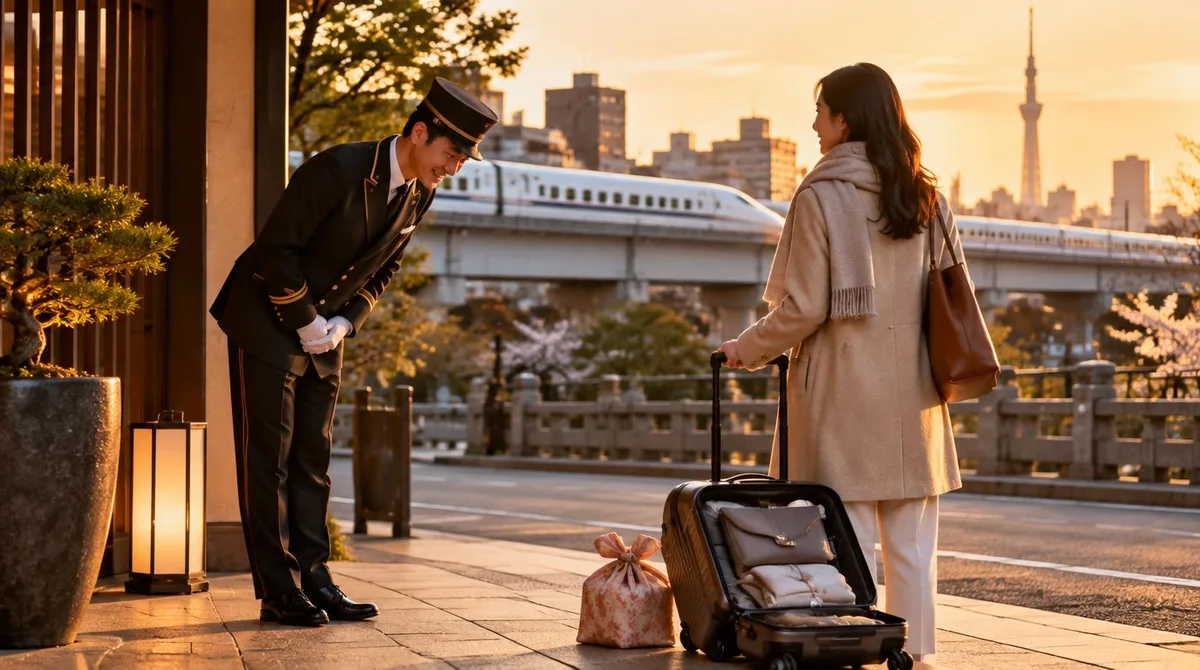
In Japan and much of East Asia, the bow does the work a handshake does elsewhere — and the depth and duration of the bow carry the message. A small nod of the head suits a casual acknowledgment. A deeper, longer bow signals respect toward an elder, a host, or a formal occasion. Visitors are not expected to master the gradations; a modest, sincere bow is read as the effort it represents.
What matters more is what you do with your hands and eyes. Hands at the sides or folded in front, a moment of stillness rather than a bob, and attention on the person rather than the mechanics. In several countries across South and Southeast Asia, a light bow of the head accompanies a pressed-palms gesture — a form that visitors can offer as readily as receive.
How close is the cheek kiss?
In much of Southern Europe, Latin America, the Middle East, and parts of Africa, greetings happen at a distance a handshake would find alarming. Friends and family exchange cheek kisses — sometimes one side, sometimes two, sometimes three, and the count changes at borders and even between households. Between new acquaintances or in formal settings, the kiss may be replaced by a handshake or a hand placed briefly on the shoulder.
The trap here is asymmetry: one person leans, the other offers a hand, and the result is an awkward mid-air negotiation. Two habits prevent it. First, follow the local person's lead rather than initiating. Second, when a kiss does come, it is cheek-to-cheek with an audible kiss into the air — lips do not land on skin. And note that in many of these regions, the close-contact greeting is reserved for people who have been introduced; it is not an opening move with a stranger.
What this means for the traveler
None of this requires memorizing a country-by-country table before every trip. The practical version is shorter:
- Wait and mirror. Let the local person initiate, then match their gesture and their distance.
- Stand up for introductions, wherever you are.
- Use names and titles until invited otherwise — asking someone directly how they wish to be addressed is itself polite.
- Keep your phone away and your attention forward during the exchange; a distracted greeting undoes the gesture.
- A wrong guess is recoverable. A smile, a brief apology, and the other person's form will close the gap.
The deeper point is that greetings are not a checklist of foreign oddities. They are the visible edge of how a place understands respect, age, gender, and distance — the same questions every society answers, in different choreography. Travelers who treat the first minute as something to learn rather than something to survive tend to be welcomed into the second and third. That is often where the culture of a place opens up: at the threshold, not the guidebook. When culture kicks against your habits at the door, that friction is information, not insult.
It is worth reading the greeting alongside everything that follows it. The rules of arrival continue into the rules of the table, the bathhouse, and the evening gathering — as our pieces on Finnish sauna etiquette and Kuwait's diwaniya show in detail. And when the accumulated small misreadings start to pile up, that is not failure; it is a stage of adjustment, as our explainer on culture shock describes. Even the ritual of sharing a drink has its own grammar of arrival, from tea ceremonies across regions to the order of a Georgian supra.
What stays unknown, and what carries you anyway
The evidence here establishes the frame: etiquette is convention, it varies by culture and context, and the basic moves — standing, matching the other person's form, keeping attention present — are documented across sources. What no guide can establish in advance is the specific form in the specific room: whether tonight's kiss is one cheek or two, whether this host bows or extends a hand. That remains unknowable until arrival, which is precisely why waiting and mirroring works. The traveler who arrives ready to be taught, rather than ready to perform, rarely stays a stranger for long.