
Pueblo pottery is built without a wheel, fired without a kiln, and signed by families whose names the art market now quotes beside any in American craft. The tradition survived the Spanish conquest, nineteenth-century suppression of Pueblo ceremony, and a curio trade that bought sacred designs cheap, and it revived in the early twentieth century through two documented figures: Nampeyo, the Hopi-Tewa potter born around 1859 who rebuilt her art from ancestral designs, and Maria Martinez of San Ildefonso Pueblo, born around 1887, whose black-on-black ware with her husband Julian put Pueblo pottery in the Smithsonian's collections and the world's museums. A traveler who understands how the pots are made, and who makes them, sees the Southwest differently.
How is a traditional Pueblo pot made?
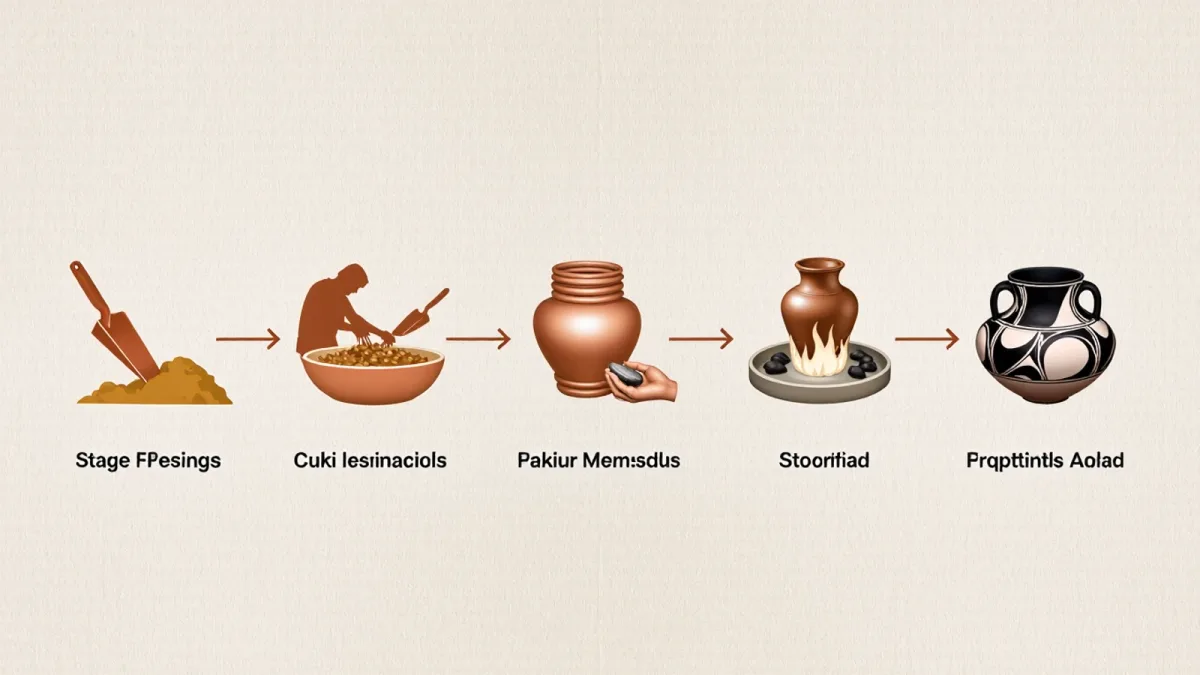
By hand, in an unbroken sequence. The potter digs clay from a source the family has used for generations, winnows it, and tempers it with crushed sherd or volcanic ash; the vessel is built from coils of clay pinched and scraped upward against a puki, the base plate, then slipped and polished with a stone until the surface shines. Firing is an outdoor event, a dung-fueled blaze reaching the temperatures that turn the slip permanently, with smothering techniques producing the black surfaces and open fire the reds and creams. The wheel never enters the process, and its absence is the craft's fingerprint: the pot's curves carry the hand's rhythm the way no thrown form does.
Each pueblo's tradition has its signature. San Ildefonso and Santa Clara are known for the polished black ware and carved designs, Hopi for yellow slips and the revived ancestral palettes, Acoma and Laguna for paper-thin walls and fine line painting, and the Taos and Picuris potters for micaceous clay that shimmers and cooks over fire without cracking. The designs are family property in the fullest sense, and a potter who paints another family's motifs without permission answers for it within the community.
What did Nampeyo and Maria Martinez actually change?
They reconnected the living craft to its ancestors, in documented ways. Nampeyo, working at Hopi's First Mesa, studied the excavated pottery of the ruined village of Sikyátki and its relatives, and began making vessels that quoted those ancestral forms and painted motifs, in collaboration with her family; the work caught the attention of traders and collectors and established that a living potter could carry a thousand-year-old design tradition forward. Her career, from the 1870s to her death in 1942, is documented in photographs, trader correspondence, and museum collections.
Maria Martinez and Julian Martinez of San Ildefonso developed the black-on-black ware in the years around the First World War, through experiment documented by the family and the ethnologists who worked with them: a polished black slip ground with matte painted designs, produced by controlling the firing's atmosphere. The ware made both their names and San Ildefonso's, and Maria's receipts, exhibitions, and honors, including work held at the Smithsonian and the famous signature shared with Julian on early pots, set a new floor for what Native artists could command. Crucially, their success lifted the whole village's market rather than only their own household.
Related stories: In Teotitlan del Valle the red comes from a bug · The furnaces of Murano have not gone out since 1291.
What is the etiquette for a respectful visitor?
Buy from the maker, ask before photographing, and know what you are holding. Pueblos distinguish clearly between open market days and ordinary life; visitor etiquette is published by the pueblos themselves, and it includes staying out of restricted areas, not entering kivas, and asking consent before pointing a camera at anyone or their work. A genuine pot is hand-coiled, unpainted on the bottom where it rested during firing, and priced to reflect weeks of work; a cheap molded import signed with a faked name is the market's known hazard, and the galleries around Santa Cruz and the pueblos' own counters are where the real thing changes hands.
The deeper rule is about the pots' meanings. Some designs and some vessels carry ceremonial content that is not for sale and not for explanation, and a visitor who asks a potter what a symbol means may be declined without rudeness. The answer to buy, respect, and learn what is offered is not concealment. It is the boundary that let the tradition survive everything else, and it is still the boundary now.
The market's history is worth knowing before the counter. The late nineteenth-century curio trade bought pots as souvenirs at prices that kept the potters poor while their work traveled east into museum cases, and the revival's achievement was partly economic: potters and the trading-post reformers who sided with them rebuilt pricing, signature, and provenance so that the maker's name traveled with the pot. Today the major auctions publish those names, family lines are studied with the seriousness applied to any school of painting, and the pueblos' own artists' markets, held under tribal regulation, return the trade to the communities that own the tradition. A buyer's diligence, asking who made the pot, when, and from whose clay, is therefore not connoisseurship for its own sake. It is participation in the correction.
Why does the revival matter beyond the Southwest?
Because it is the clearest case on record of a colonized art form returning to center through its own practitioners. The twentieth-century market took Pueblo pottery seriously as art, at prices and in museums, decades before most Native American traditions received that recognition, and the potters themselves, Maria Martinez most famously, negotiated that recognition in person, on their own terms, for decades. The trade signs at the pueblo entrances now read like galleries' rosters. The clay beneath them is the same clay, dug by the same families, from sources the potters will show you the direction of and never the map.