
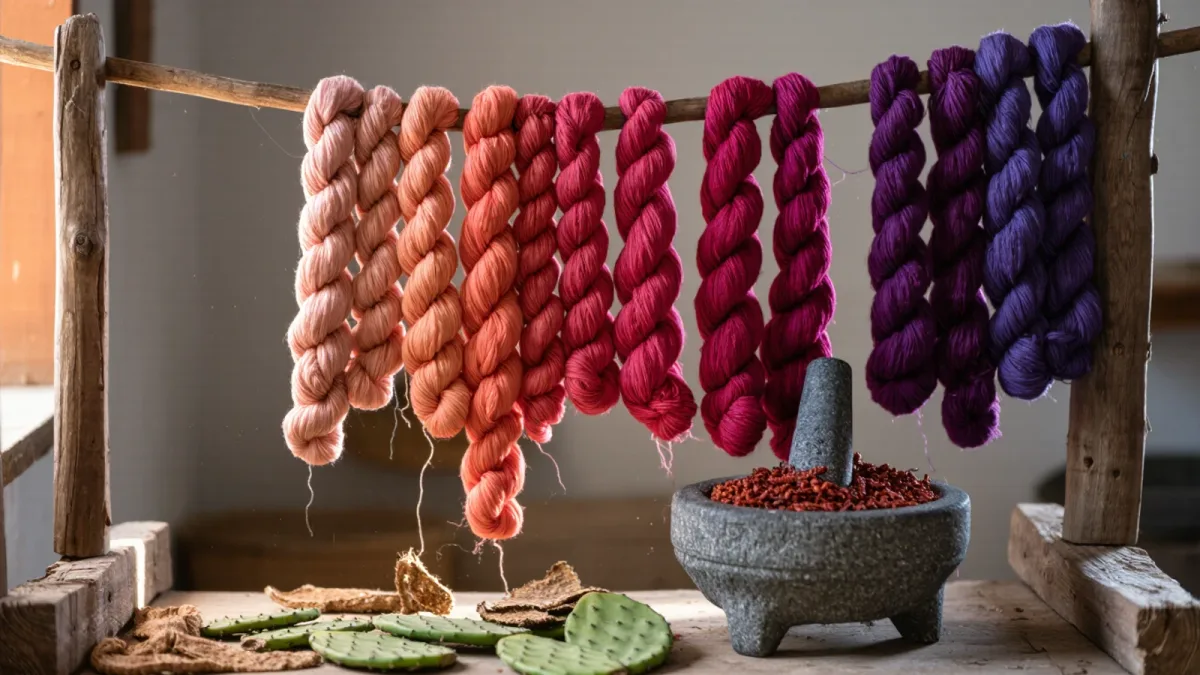
Teotitlán del Valle, a Zapotec town in the Tlacolula valley east of Oaxaca city, weaves wool on pedal looms and dyes it, in the workshops that keep the old ways, with a red that comes from a small scale insect farmed on prickly pear cactus. Cochineal was, by the late sixteenth century, the second most valuable export of New Spain after silver, a documented fact of empire, and in Teotitlán it never quite left: the village's family workshops still grind the dried insects on stone, ferment the vats, and shift the color with lime and pomegranate rinds, in a dye chemistry the modern synthetic trade cannot imitate at any price.
How did weaving come to define the town?
Through a layered history the town acknowledges plainly. Cotton and weaving long predate the Spanish arrival in the valley, but the Spanish colonial administration introduced sheep's wool and the pedal loom in the sixteenth century, and the Zapotec weavers of Teotitlán absorbed both into their own practice, producing cloth for the colonial economy while keeping local designs in the work. The village's patron, the Precious Blood feast and the town's church on its pre-Hispanic platform, mark the same layering in stone. By the twentieth century the looms had turned from cloth to rugs, and the town's estimated thousand-plus family workshops, by local counts, now weave for markets from Oaxaca city to abroad.
The workshop is a family economy in the exact sense. Children grow up carding; the looms occupy the courtyards; grandparents sort wool for the fine pieces. A visitor walking the side streets hears the looms' clack from behind open doors, because most of the town's production happens where the families live, which is why the buying etiquette matters so much here.
What is cochineal and how does the dye work?
Cochineal is the dried female of a scale insect, Dactylopius coccus, that lives on the pads of the nopal cactus, and its body carries carminic acid, one of the strongest natural reds known. The dye's chemistry is the workshop's pride: ground cochineal yields crimson in an acid bath, shifts toward orange with the addition of an acid like pomegranate, and toward purple and deep plum with alkaline lime or iron. The same grounds dye again; the vats are living chemistry passed down in the family, and the pales and pinks of a fine rug are the same insect as the dark reds, pulled thinner or shifted with minerals.
The historical weight is real and the weavers carry it knowingly. Cochineal was farmed in Oaxaca under tribute systems before the Spanish arrived, became a global monopoly commodity afterwards, and colored the cardinals' robes and British army coats of Europe from the sixteenth century onward. The synthetic dyes of the late nineteenth century collapsed the trade's price, and the village's return to natural dyes in recent decades, driven by weavers who refused to let the vats die, is a deliberate cultural and commercial decision, documented by the cooperatives that teach it.
The wool's own biography completes the picture. Local sheep supply the fleece; hand-carding and spindle spinning persist in the workshops that make the finest pieces, while machine-spun commercial yarn serves the production lines; and the washing, with earth-root soaps such as amole, precedes the dye vat. Each step leaves evidence a knowledgeable buyer can read: irregular slubs in handspun yarn, slight color variation between skeins of the same bath, colors that glow from within the fiber rather than sitting on it. Weavers explain these differences patiently to visitors, because the ability to see them is the best protection the honest workshop has against the cheap imitations stacked in the market stalls a valley away.
Related stories: The children who sing England's cathedrals every day · The potters of the pueblos kept their clay.
How should a visitor approach the workshops?
Through the door that is open, with time and courtesy. Many families welcome visitors into the courtyard, demonstrate the carding, spinning, dyeing, and loom, and answer questions about designs; a demonstration is hospitality, not an obligation to buy, but the family that spends an hour teaching deserves a purchase or, if the rugs are beyond the budget, an honest word and a small payment for the demonstration. Prices for naturally dyed, hand-spun, large-format rugs run high because the work is measured in months, and a visitor should be suspicious of both too-cheap "cochineal" work, often synthetic, and any claim that a village has one best workshop. It has hundreds.
Photography deserves the same respect. Ask before photographing people or looms in use; some weavers decline, some ask that specific ceremonial designs not be copied in detail, and both requests are the workshop's right. The designs themselves carry meanings the weavers explain variously, geometric Zapotec motifs read as calendars, gods, and daily life, and the best conversations start from a rug that genuinely moves you rather than a checklist of symbols.
What does the future hold for the vats?
More life than the synthetics were supposed to leave them. The town's young weavers have marketed natural dyeing as exactly what it is, a documented, traceable, labor-intensive craft, and the international market for verified natural dye has followed them back to the cactus fields where the insects are farmed. The village's dye gardens, its cooperatives, and its annual ferias keep the knowledge in public view, and the cochineal's second act, five centuries after it first left Oaxaca for Europe, is being written at family scale, one ground handful of insects and one pedal loom at a time.