The word borrowed carries a quiet promise. To borrow is to take something on loan, use it for a while, and hand it back whole. The dictionaries are strict about this. Cambridge Dictionary treats "borrowed" as the past participle of a verb whose first meaning is exactly that: obtain something with the promise of returning it or its equivalent. A borrowed journey works the same way. You take up a book, live inside someone else's movement through the world for a few hundred pages, and return the book unchanged. You are the one who comes back different.
This is the oldest bargain in reading, and it may be the closest thing to travel that requires no luggage. A novel or a short-story collection can put a reader on a night train, in a foreign kitchen, at a border post at dawn, with more texture than most itineraries manage. The writer has already done the slow work: the listening, the misundertandings, the small humiliations of not knowing where anything is. The reader inherits all of it, interest-free.
There is a case to be made that fiction travels further than reportage, precisely because it is free to be true in ways a guidebook cannot afford. An essay on this site once argued that the travel story outlasts the checklist, and fiction is the extreme form of that claim. A checklist tells you what a place has. A story tells you what a place does to people.
What a borrowed journey actually gives you
It gives you the interior. This is the one thing no trip can supply and every good novel can. Stand in a square in a city you have never visited and you see the square. Read a novel set there and you also see who is watching, who is waiting, who is lying, and what the square meant to someone twenty years ago. The physical detail is the same; the depth of field is not.
It also gives you permission to be a stranger. In life, being lost is tiring. In fiction, being lost is the plot. The reader who has spent three hundred pages not knowing the language, the money, or the rules has rehearsed something useful: the posture of humility that real travel demands. The discomfort an itinerary usually edits out is the very substance of the borrowed journey.
And it gives you company without obligation. A reader can leave a country by closing a book, and the country does not mind. That lightness is not a failure of commitment. It is what makes the reading version of travel sustainable for people who cannot leave, cannot afford to leave, or cannot yet leave.
Why short stories are the sleeper cars of literature
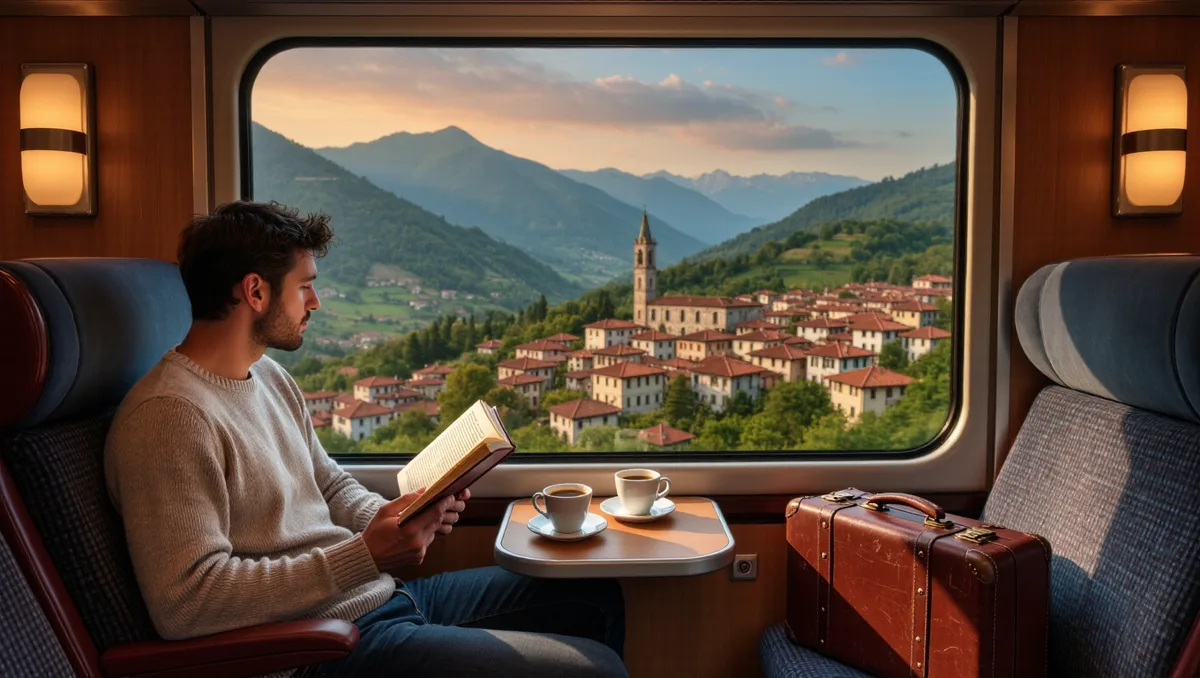
A short-story collection behaves like a set of sleeper cars on a long train. Each one is a small, sealed compartment. You enter, the door closes, the landscape runs past the window, and some hours later you arrive somewhere you did not plan to go. Then the next story opens a different compartment, often in a different country, and the rhythm of departure and arrival becomes the reading experience itself.
Readers who already enjoy this rhythm on the page will recognize it from another piece here: the night train as a genre, and the sleeper cars as its library. The connection is not decorative. Both forms trade in transition. Both keep the passenger suspended between an origin and a destination, which is where people tend to tell the truth. This connects to our earlier piece, The night train is a genre, and the sleeper cars are its library.
The short story's compression is its advantage as a vehicle. A novel must build a world; a story can drop you into one mid-sentence, the way arrival actually feels. You do not get the briefing. You get the street, the weather, the tone of voice, and you must infer the rest, exactly as a traveler does.
What this means for how you read
Our analysis is simple: treat a novel set elsewhere as a legitimate form of travel, not a substitute for it and not a consolation prize. The two experiences do different work. A trip gives you the present tense of a place. A book gives you its accumulated past and its private lives, which no visitor can access directly. A reader who has lived inside a place on the page arrives, when they finally do, with more patience for it.
Practically, this suggests a slow habit rather than a program. Choose books set in places you may never see as well as places you might. Read across borders; let one country's writers answer another's. Notice what each story assumes you already know, because that list of assumptions is a map of the culture's own blind spots. And when a book sends you somewhere, resist the urge to immediately verify it against photographs. Let the invented version and the real version stay separate for a while. They will introduce themselves later.
The return, and what it costs
The dictionaries are firm that borrowing ends in returning. The Free Dictionary defines the verb plainly: to obtain something on loan for temporary use, intending to give back the same or an equivalent. But a borrowed journey breaks that rule in one direction. You return the book; you keep the journey. Nothing in the transaction asks for repayment, which is perhaps why readers who travel by page often become travelers in fact. The debt of curiosity compounds.
There is also a gentler reading of the word. To borrow, in one of its older senses recorded in English, is to adopt an idea from another source and use it as your own. That is what the best travel fiction does to a reader. It lends you a way of seeing, and you quietly keep it. You begin to notice the specific light of an unfamiliar afternoon, the etiquette of a market, the weight of a language you do not speak. These are borrowed perceptions, and they persist long after the cover is closed.
The honest conclusion is that fiction will not take you anywhere. It will only convince you, thoroughly and permanently, that somewhere else exists, that it is complicated, and that its people are not waiting to be discovered. That conviction is not a smaller journey than the physical one. It may be the necessary first leg of it. The essays in this collection return often to the idea that there is no such thing as a traveler, and never was — only people moving, some by plane and some by page, all of them borrowing.