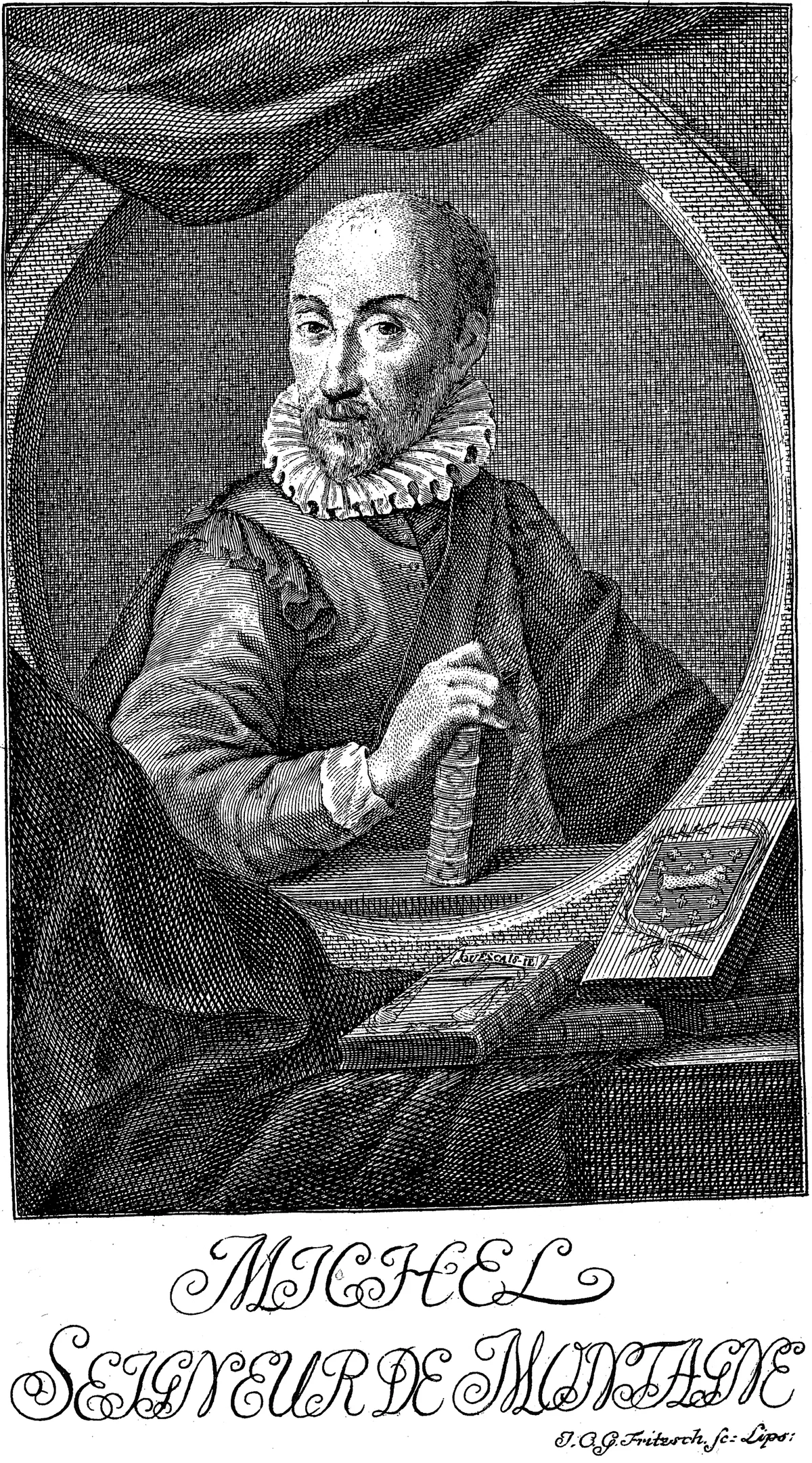
Montaigne did not write travel essays the way we now read them. He wrote a private journal of a journey to Italy in 1580 and 1581, mostly for himself, and the manuscript was not found until the eighteenth century. According to the Stanford Encyclopedia of Philosophy, the trip had a plain medical purpose: to ease the pain of kidney stones at thermal resorts. That unglamorous reason for travel is the first lesson. People have always traveled for reasons more ordinary than wonder, and the record is more honest when it admits it.
The man behind that journal is worth knowing on his own terms. Per Wikipedia, Michel Eyquem de Montaigne was born on 28 February 1533 at the family estate near Bordeaux and died there on 13 September 1592. He served as a magistrate, twice as mayor of Bordeaux, and spent his retirement writing the Essais, the book that popularized the essay as a literary form. His subject, as he said himself, was himself. His contemporaries found that self-indulgent. Readers since have found it the beginning of something: the admission that a travel account is really an account of the person doing the traveling.
That is the thread this piece follows. What can a sixteenth-century magistrate, riding toward Italian spa towns in search of relief for his gravel, still teach anyone who keeps a notebook on the road? Quite a lot, it turns out, and most of it is about restraint.
Why does the father of the essay matter to travel writers?
Because he invented the shape most honest travel writing still uses. An essay, in Montaigne's sense, is a trial, a weighing, an attempt. It does not conclude so much as it follows a thought to where the thought gets uncertain. The Stanford Encyclopedia notes that Montaigne enriched his text continuously across editions, preferring to add for the sake of variety rather than to correct, so that the work reads as thinking in progress rather than a finished argument.
Travel writing often does the opposite. It arrives at certainty. The country is charming, the train was late, the meal was a revelation. Montaigne's habit was to notice the judgment forming and then ask what it rested on. His famous skeptical shrug, "What do I know?", is not a pose of ignorance. It is a discipline. For a writer in a foreign place, it is the difference between recording an impression and mistaking the impression for the place. We covered a connected angle in The quiet habit of watching other people's travel stories.
What did his journal actually record?
Small things, and unafraid of their smallness. The journal mixes entries written by Montaigne with entries written by a secretary, and it tracks the practical substance of a journey: baths, inns, distances, costs, the customs of the towns he passed through. La Wikipédia française records that the Journal de Voyage was published after his death, alongside other scattered writings, and that the trip itself grew out of illness and curiosity, a search for cures in the places that had fascinated his youth.
There is no arc in it, no lesson staged at the end. That refusal is instructive. A notebook that only keeps what supports a theme is not a notebook; it is a draft of the story already decided. Montaigne kept the baths and the road conditions next to his moods, and let them sit together without ranking them. The modern writer, tempted to cut everything that does not serve the point, loses exactly the texture that makes a place legible later.
How did he handle being a foreigner?
By noticing his own reactions rather than pronouncing on the people. The Stanford Encyclopedia observes that Montaigne shook at fundamental assumptions of Western thought, among them the assumed superiority of European civilization over so-called barbarians. He was skeptical of the confidence with which his own culture judged others. For a travel writer, that skepticism is a working tool, not a mood. It asks: on what evidence do I call this custom strange? Strange compared to what, exactly?
This is where his method and the slow-travel temperament meet. The writer who stays a while, who lets the unfamiliar become ordinary, is practicing what Montaigne practiced at his desk: holding a judgment open long enough to see it change. Our essays on the plotted route and the wander make a related argument about two kinds of knowing; Montaigne's journal belongs to the second kind, the kind that does not know where it is going and reports faithfully on not knowing. Readers following this should also see The plotted route and the wander are different kinds of knowing.
What this means for the notebook you keep
Three habits, all drawn from his practice rather than from any modern manual. First, write the ordinary fact beside the feeling. The price of the room, the state of the road, the name of the town, next to whatever the day did to your spirits. Montaigne's journal survives precisely because it did not sort its entries into the important and the trivial.
Second, revise by adding, not by polishing toward a verdict. He returned to the same passages across editions and layered them, so the earlier thought and the later one are both visible. A travel notebook revised the same way becomes a record of how your understanding of a place moved, which is often the truest story a trip has to tell. Our piece on going back to a childhood place reaches a similar conclusion from the other direction.
Third, keep the doubt in the draft. The sentence "I don't yet understand why this market closes at noon" is worth more than a confident sentence about the market, because it is checkable and the confident one usually is not. Montaigne's contemporaries thought his digressions and personal ruminations damaged his style. Time has ruled otherwise, and the digression, the honest aside, the admitted uncertainty, now reads as the strongest part of the page.
What the evidence leaves unsettled
The journal was not meant for readers, so it cannot be taken as a literary performance the way the Essais can. Some of it is in a secretary's hand, and the manuscript's later fate, discovery in the eighteenth century and then near-forgetfulness, means the text's own history is tangled. What is certain is the practice: a man of public standing, ill and traveling for his health, wrote down what he saw and what he thought about what he saw, without pretending the two could be separated. That separation, between the place and the person watching it, is the one travel writing never fully makes. Montaigne is worth reading because he said so first, and said it without embarrassment.