
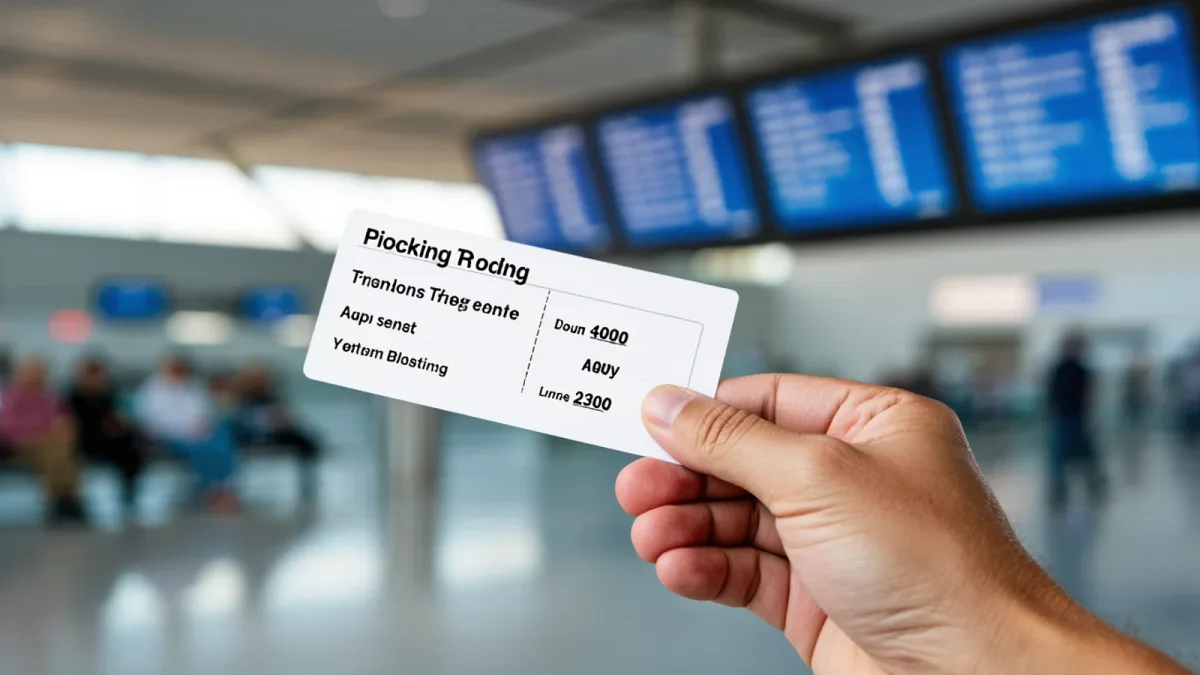
Consider what the airport asks of you, which is almost nothing. Be legible to a camera, obedient to a line, presentable to a scanner, and reachable by your phone. In exchange it offers seating, light, food calibrated to the layover, and a departure board that is the only object in the building anyone truly reads. When the anthropologist Marc Augé named this condition in his 1992 book "Non-Lieux," translated into English in 1995 as "Non-Places: Introduction to an Anthropology of Supermodernity," he gave the transit lounge its lasting description: a space "which cannot be defined as relational, or historical, or concerned with identity." The airport is the purest non-place we have built — and by ICAO's count, air travelers passed through something like 4.5 billion of these transits in 2019 alone, which makes the non-place one of the most inhabited human environments on earth despite being, in Augé's strict sense, unlivable.
What a non-place is, exactly
Augé's distinction is clean. A place, in his anthropology, is invested with history, relationship and identity: the café where the waiter knows the order, the square named for a local event, the street whose very stones carry argument and memory. A non-place is the opposite pole: designed for circulation, contract and anonymity. Motorways, hotel chains, supermarkets, and above all airports and their sibling, the duty-free hall. In a non-place you are not a person with a history; you are a role with credentials. The boarding pass — that laminated rectangle of conditions and codes — is the non-place's entire theory of who you are. Nobody in the security queue is curious about you; the system asks only that your identity verify and your liquids measure under a hundred milliliters.
The definition explains the airport's peculiar emotional signature. It is why the airport feels like nowhere even when it is somewhere extraordinary — why a hall in Singapore and a hall in Frankfurt can be functionally interchangeable, down to the same gate-podium posture and the same cinnamon-scented bakery concession. Augé's point was not that such spaces are bad. It was that they are new: that supermodernity produces, alongside its places, an expanding archipelago of spaces whose whole purpose is to be passed through, and that a person can now spend measurable years of a life inside them without ever dwelling.
The transient's contract
What the non-place demands, and gets, is a specific kind of presence. The philosopher's vocabulary for this is thin, but the airport's own signage is eloquent: no statement in the building is addressed to you as an individual. Every instruction — board now, gate change, do not leave baggage — is addressed to whoever qualifies. The non-place speaks in the conditional plural, and its inhabitants respond in kind: headphones in, gaze down, transactions minimized. Sociologists of air travel have documented the resulting choreography for decades — the queue as moral technology, the body scanned into a category, the peculiar solitude of seats arranged in forward-facing rows of eight hundred.
Yet the contract cuts both ways, and this is where the usual lament about non-places oversimplifies. The anonymity is also a release. The airport is one of the few environments where no one is expected to be anyone: stripped of neighborhood, profession and history, the traveler experiences a suspension that some find bleak and some find, quietly, luxurious. The non-place does not care who you were at home. The ticket line does not remember. There is a freedom in being, for ninety minutes, exactly as legible and exactly as anonymous as everyone else in the hall — a democratic flatness that no city square, with its residents and its regulars, has ever offered a stranger.
Related stories: The month between months is when a place is most itself · Going back is the strangest trip a traveler takes.
What leaks through
The non-place's claim to placelessness was always partly ideological, and the leaks are where an honest essay has to stop. Airports are intensely local in everything they pretend not to be: the food court's regional franchises, the departure-hall architecture that markets a city to itself, the labor of the cleaning crews and ground staff whose shifts structure the building's real life. Watch an airport for a full day and it resolves into a small town with unusual demographics — a place in Augé's own sense, complete with insider knowledge (which security line moves; which gate's fountain runs cold) and vernacular ritual (the shoe re-lacing, the gate-change sprint). Augé himself allowed that no one wholly inhabits the pure non-place; the concept describes a tendency, not a hermetic seal. Travelers leak humanity into the hall constantly: the reunion at arrivals, which no duty-free layout has ever managed to make casual, and the peculiar confessions exchanged between seat-neighbors who will never meet again, precisely because the non-place guarantees it.
Traveling through without being traveled through
The essay's practical residue is small and, fittingly, observational. The non-place rewards the traveler who treats its anonymity as material rather than annoyance: who reads the departure board the way one reads a tide table, who notices which concessions the local market has actually claimed, who registers the arrivals hall — the one space in the airport where the non-place breaks, where relation and history pour through the doors every few minutes — as the building's true center. Augé wrote his book as a warning with a shrug: these spaces multiply, they organize more and more of ordinary life, and an anthropology that ignores them misses half the modern world. He did not prescribe a remedy, because there isn't one. The airport will not become a place, and should not; its function is passage. But a traveler can pass through a non-place two ways — asleep inside the contract, or awake enough to notice that even here, in the most placeless architecture ever built, people keep arriving from and departing to somewhere, and the somewhere keeps showing through.
The layover as an accidental genre
Somewhere between the lament and the shrug, a small literature of the layover has grown up, and it takes the non-place seriously as a subject rather than an obstacle. Guidebook publishers now sell multi-city itineraries designed to exploit long transits; some hub airports have responded with transit tours, city previews compressed into the space between connections, and nap-pod franchises priced by the hour. None of this converts the non-place into a place, and it does not try. What it acknowledges is that the hall has become a destination in the most literal, denuded sense: somewhere people now allocate time, spend money and form routines, without ever claiming to have been there. The lounge regular who knows the quiet corner by gate B22 and the exact minute the sandwich counter restocks has, in every behavioral sense, a neighborhood. It simply declines to be called one.
That is the final twist worth sitting with before the gate change. Augé built his category to keep anthropology honest about the new spaces, not to rank them below the old ones. The medieval cloister and the modern concourse both impose choreography on strangers; only one of them advertised itself as eternal. The non-place is honest about what it is — a machine for moving people through without friction — and it extends a modest invitation to anyone delayed inside it: notice the machine. Notice who runs it, what the local market has made of it, where it fails into humanity at arrivals. Passage is not the opposite of attention. Even ninety minutes of nowhere, read closely, is somewhere.