The hospitaleros of the Camino de Santiago are the reason a walker can sleep for a donation in a village with no hotel. They are volunteers, most serving two-week shifts in the donativo shelters, cooking, sweeping, and stamping credencials, and the tradition they carry is older than every national trail in Europe: medieval hospices were caring for pilgrims on the road to Santiago by the twelfth century, when the route itself was still being defined. When the Council of Europe named the Camino Francés its first European Cultural Route in 1987, it was recognizing a walking culture whose infrastructure had always been part hospitality, part faith.
What did the medieval hospices actually do?
They did what the shelters do now, with less equipment and more certainty about why. The twelfth and thirteenth centuries built a chain of hospitals along the French Way, some attached to monasteries, some endowed by guilds and brotherhoods, with a stated duty to take in pilgrims without payment. Their records survive in the archives of the great route towns, and their rules anticipate every modern shelter's choreography: the traveler was admitted, washed or treated if needed, fed, housed for the night, and sent off at dawn with a blessing and, in the better-endowed houses, bread for the road. Some hospices kept beds specifically for the sick and the dying, which made them part infirmary and part hospice in the modern sense.
The people who worked them were usually religious or members of lay confraternities, vowed for a term rather than a lifetime. That model, service for a season, is precisely what the modern hospitalero training programs revived when walking the route surged in the late twentieth century.
The route's anchor points still carry the old institutions' names. Roncesvalles, the collegiate church in the pass below the Pyrenees, has received pilgrims since the twelfth century, and its medieval statutes survive in print: provisions for the sick, for confession, for burial of those who died on the road. San Juan de Ortega, a twelfth-century hermit and builder who worked on the route's bridges and churches, founded a hospice at the place that took his name, and the building still stands beside the road a day's walk from Burgos. These were not informal charities. They held endowments, kept staff, and answered to visitations, which is why their accounts can still be read.
Who are the hospitaleros today?
Mostly retirees, teachers, and former pilgrims, drawn from associations across Europe and the Americas. The larger confraternities run weekend training courses in how a donativo shelter works: how to cook for sixty on two burners, how to mediate a dormitory quarrel, how to receive someone who arrived on the route carrying more than a pack. A volunteer typically commits to a shift of about two weeks, lives in the shelter, takes no wage, and asks no fee of guests, since donativo shelters run on donations left by the pilgrims themselves.
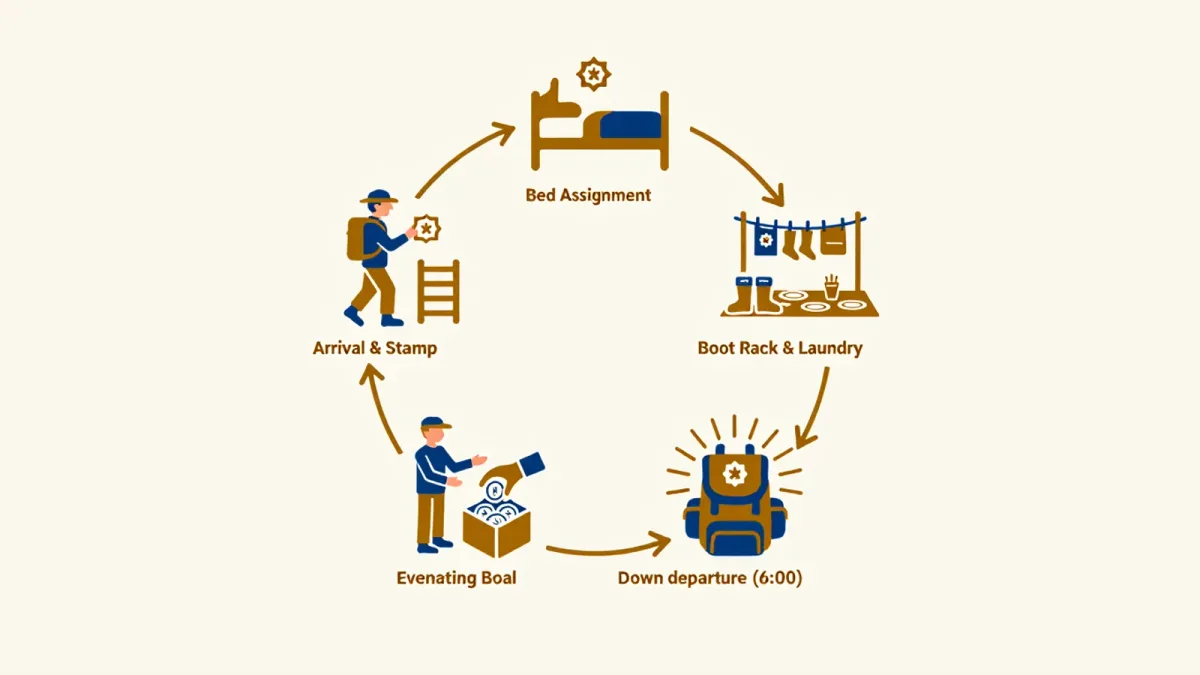
The work is deliberately unglamorous. Hospitaleros describe their duties in lists: sweep the floor twice, hang wet boots, prepare the evening meal, learn thirty names by bedtime, wake the house at six. The associations insist on one rule that sounds soft and is not: the host serves everyone, the fast walker and the struggling one alike, without sorting them by worthiness. It is the medieval rule, restated.
Why does the tradition matter to the towns?
Because in much of northern Spain the shelter is a civic institution, not a business. A donativo albergue in a village of two hundred people may be the only year-round public building, kept open by a rotating cast of outsiders who arrive knowing nobody and, within a day, feed everybody. The parish priest holds a key; the town supplies firewood; the pilgrims leave donations that keep the roof repaired. When the volunteers are fewer in a slow season, the whole village notices, because the evening meal is also the village's evening news.
The route's own arithmetic depends on them. Tens of thousands of pilgrims a year walk stretches where no commercial bed exists at a price they can pay, and the shelters make those stretches walkable at all. A Camino without hospitaleros would not be a harder Camino. It would be a shorter one, ending where the money runs out.
The modern revival tracked the route's return to mass walking. As numbers grew in the 1980s and 1990s, parishes and town councils reopened shuttered shelters, and the confraternities of former pilgrims in France, Britain, Germany, the Netherlands, and the Americas began sending trained volunteers to staff them. The result is a labor system that spans borders without being run from anywhere: a Dutch hospitalero may serve in a shelter on the meseta kept open by a Galician parish, funded by donations left mostly by Spaniards on holiday weekends. Nobody owns the arrangement. It holds because each generation of walkers contains enough people who remember being received well and want to return the reception.
What should a pilgrim understand about staying in one?
That the donation is not a price and the host is not staff. Donativo means the shelter exists on what guests choose to leave, and the convention is to give what the stay was worth to you, including enough to fund the next stranger. Lights out follows the volunteer's announcement, not personal preference, because the host is up before everyone to start the next day's soup. The old hospices asked pilgrims to treat the house as their own; the modern ones ask for the same thing, minus the blessing, unless you want one.
Ask a hospitalero why they do it and most answers circle the same observation, recorded in the medieval rules and unchanged since: everyone who walks in has earned the night. Nine hundred years is a long time to keep one social arrangement running. The people who keep it are not sentimental about it. They are simply on shift.