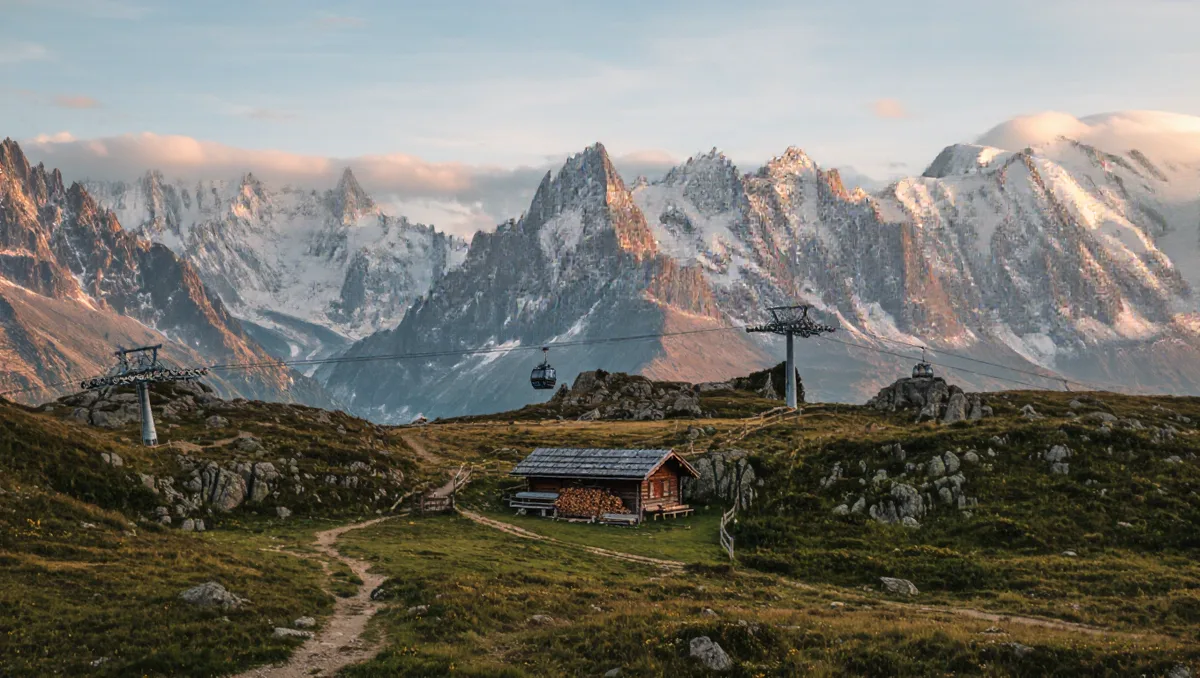
The Dolomites reward people who keep moving. The range in northeastern Italy spans seven provinces and three regions, and the standard advice is to treat it like a checklist: Tre Cime, Lago di Braies, Seceda, then home. The Italian name Dolomiti carries the older story better. The first vernacular name for these peaks was Monti Pallidi, the Pale Mountains, a color that arrives only at sunset, when the carbonate rock catches the last light and turns reddish to purple in the alpenglow.
That light is the argument for staying still. A week in a single valley, walking the same trail each morning, is not a smaller version of a Dolomites trip. It is a different kind of trip, closer to what the mountain communities themselves have always done with these slopes: return to them, daily, in changing weather. The range was declared a UNESCO World Heritage Site on 26 June 2009, and the designation covers the landscape's geological drama as much as its scenery. Drama like that does not exhaust itself in one visit. For related coverage, see How Norway's mountain huts still run on a stranger's honesty.
This piece is a feature built on documented sources rather than a diary, but the question it pursues is the one a slow week asks: what does a place give back when you stop trying to collect it? The stories this publication returns to, from the volunteers who keep Alpine paths open to the Norwegian hut system that runs on a stranger's honesty, all circle the same idea. Mountains are not consumed. They are revisited. We covered a connected angle in Who keeps the Alpine paths open.
Why one valley instead of ten summits
The practical case for a base is well documented. According to Earth Trekkers, the range is bigger and more spread out than it looks on a map, the roads twist over passes crowded with tour buses and cyclists, and even a central base town can mean a long drive to anything famous. Their conclusion after nearly two weeks in the region was blunt: choosing the right base matters more than most first-time visitors expect.
Flip that logistics problem and it becomes a philosophy. If driving distances punish the checklist traveler, they quietly favor the one-valley traveler. A week spent in the Fassa, Gardena or Badia valleys, which the range's main visitor centres include, turns the mountain passes from transit into background. The trail from the village door becomes a fixed point, and everything else, weather, light, season, moves around it.
What the same trail gives back each day
Walk one path repeatedly and the mountain stops performing. The first day is scenery: pale walls, green meadows, the postcard. By the third, the walk is a clock. Marmots whistle from the same boulders. The morning shadow of the ridge falls a little shorter or longer than yesterday. According to Guide to Italy, the rock that makes up these peaks was once the floor of a shallow tropical sea, thrust upward by the collision of the African and European tectonic plates, and the sunset glow it produces has a local name, the Enrosadira, with a Ladin legend of a dwarf king's rose garden attached to it. Watching that light from the same bench seven evenings in a row is a different education from photographing it once.
The range supports this kind of repetition structurally. Long-distance footpaths called alte vie, numbered one to ten, cross the Dolomites and are served by numerous rifugi, the mountain huts that feed and shelter walkers. Alta Via 1 takes about a week to walk. But a week does not have to be linear. The hut network works just as well as a day-walk spine: sleep low, walk high, return, repeat.
How the crowds shape a slow week
The famous sights run on tight schedules, and knowing those schedules is what frees a slower trip from them. According to Savoring Italy, the parking area at Tre Cime di Lavaredo fills fast in summer and the crowds by mid-morning are real, which is why an early start before 7:30 is advised; at Lago di Braies, cars are banned from the access road between 9:30am and 4pm between July and early September. For the one-valley traveler, those warnings read as a gift. The icons are at their best at dawn, and by the time the tour buses arrive, a slower walker is already back on an unnamed trail above a different valley.
The hiking season runs from June through early October, with July and August the busiest months and late June or September the quieter sweet spots. September has a particular quality in these valleys: the larches have not yet turned, the huts are still open, and the light arrives at a lower angle, which deepens the alpenglow the Pale Mountains were named for.
What this means for how you travel here
The Dolomites are not a budget destination, and a week anywhere in them costs real money, so the slow version should justify itself honestly. It does, on two grounds. First, depth: the region's cultural texture, Italian, Germanic and Ladin at once, with a living Raeto-Romanic language spoken daily in valleys like Val Gardena and Alta Badia, is legible only to someone who stays long enough to hear which language the bakery uses and which the church bell follows. Second, the war history. The First World War front between Italian and Austro-Hungarian forces ran through these peaks, and the vie ferrate, the protected cabled paths hikers still climb, were originally built by troops to move supplies. Walking the same route daily past those remnants turns them from a sight into a presence.
Practically, the slow week asks for three commitments. Pick one valley and stay in it, accepting that the icons will be day trips rather than checkpoints. Book early if traveling in peak season, since the guidance across sources is consistent that demand outstrips beds. And spend at least one night or one long lunch in a rifugio, where the food is South Tyrolean and the pace is the mountain's own.
What a week in the Dolomiti leaves behind
The evidence points one way. A Dolomites trip organized around ten named sights produces ten photographs and a full camera roll. A week in one valley produces something less transferable: the memory of a single ridge under seven different skies, and the recognition that the range's most famous color, the one that named it the Pale Mountains, only appears to people who are still there at sunset.
What remains unknown is personal rather than factual: which valley will hold a given traveler. The sources agree the east and west differ in character and that no single base serves both. That choice, made slowly and locally, is the trip.