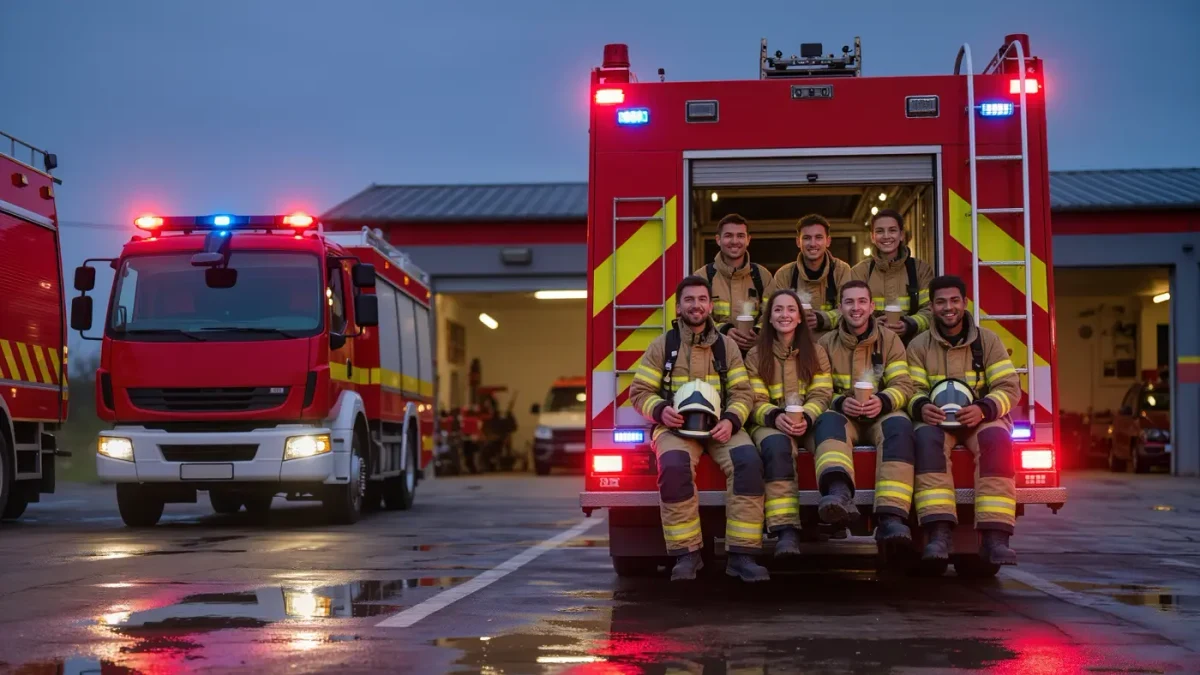
The Cornish lifeboat crews are neighbors with a second profession. The Royal National Lifeboat Institution, founded in 1824 as the National Institution for the Preservation of Life from Shipwreck, has kept lifeboats along Cornwall's cliffs and harbors for two centuries, and its crews are, as the institution states plainly, around 95 percent volunteers, people who harvest fish, teach school, or run garages until the pager sounds, then drop whatever they are doing and put to sea. On a summer evening in a Cornish harbor town the launch is still the most civic thing that happens: an air horn, runners on the quay, and a boat going out crewed by people the whole town can name.
How does a volunteer crew actually work?
On a pager and a hierarchy of readiness. Each station keeps a crew list, a launching arrangement with the coastguard, and a boat ready to a published launch time; when a call comes, the honorary secretary assesses it, the pagers go out, and the crew musters from workplaces, beds, and family dinners. Training is continuous and institutionally serious, the RNLI runs its own college and certification, because a volunteer service that asked less than a professional one would not survive its own rescues. Crews drill on capsizing, night search, and helicopter winch work with the same regularity the tide keeps.
The social mechanics are as designed as the drills. Stations recruit from the working waterfront first, because crew members need jobs that let them leave and skills that the sea already taught; employers who release staff at a run are remembered in town as part of the service. The crew's families accept a particular arithmetic, that dinners go cold and boats come back late, and the institution's culture treats that acceptance as part of the launch rather than a footnote to it.
What does the coast demand of them?
Everything the geography suggests. Cornwall's coastline mixes industry and leisure in the least forgiving way: pasty wrecks and winter gales on the one hand, and on the other one of Europe's densest summer populations of swimmers, surfers, kayakers, and cliff walkers, many of them visitors who misread an Atlantic sea state. The stations' callouts reflect both economies, merchant distress and fishing boats a century ago, inflatable dinghies and cut-off tide pools now. The lifeboats work alongside lifeguard units, coastguard teams, and search-and-rescue helicopters, but the lifeboat remains the only rescue asset that can put to sea from a small harbor in weather that grounds everything else.
The service's memory holds its hardest cases with dignity. On 19 December 1981 the Penlee lifeboat Solomon Browne, launched from Mousehole in hurricane conditions to the coaster Union Star, saved the coaster's crew from the rocks and was lost with all eight of her own crew; the inquiry and the station's records are public, and the county's memorials to the Penlee crew are maintained with a devotion that tells visitors exactly what the volunteer principle costs at its limit. Every station's boathouse carries its own roll of service, and the summer crowds walk past it on the way to the ice cream.
The boats themselves tell the institution's engineering story in miniature. Early pulling boats were rowed from beaches and capstanned down slipways by the village; steam and then motor driven relief fleets followed; and the modern all-weather lifeboats are among the most capable small vessels afloat, self-righting, designed and built by the institution's own engineering arm, and able to work far offshore in weather that keeps helicopters grounded. Between the all-weather boats and the shore, the inshore lifeboat, introduced in the 1960s for shallow water and swimmer rescues, transformed the summer service, putting a fast, light craft at every busy beach station. Each generation of equipment changed the work and none of it changed the staffing model, which remained the pager and the parish.
Why volunteers, still, after two hundred years?
Because the system's economics and its sociology both favor them. A professional crew at every small station would be unaffordable, but that is the shallow answer; the deep one is that a crew drawn from the harbor knows the water, the weather's habits, and the names of who is out there, which no payroll can purchase. The institution's founders in 1824 reasoned from shipwreck that rescue must be organized, funded by subscription, and staffed by the people on the spot, and the reasoning has survived steam, diesel, radio, and satellites unchanged in its essentials.
The volunteers' own reasons are recorded in the institution's oral histories with great consistency: family precedent, the town's expectation, and the bare fact of being the person nearest the water. A Cornish station's crew list reads as local history, the same surnames across a century, the sons of crews on the boats of their fathers' stations.
Storms write the service's defining chapters, and Cornwall's are legend in the institution's records: the rescues of whole crews from wrecked merchantmen in the age of sail, the long tow home of a disabled trawler through a rising sea, the summer multicasualty calls when a squall catches a fleet of dinghies. The boathouses' service boards compress these into dates and initials, and the stations' archivists, usually retired crew, keep the fuller accounts. A visitor who reads a station's board slowly will notice the pattern beneath the drama, that the same names recur across decades of entries, which is the volunteer principle expressed not as a slogan but as a roster.
What can a visitor do with this knowledge?
Use it as the coast intends. Check the tide times and the flag warnings that the lifeguard service publishes, swim between the flags, and understand that the majority of the service's summer launches answer avoidable calls. Visit the station open days that most towns hold, where the boat is shown, the crew answers questions, and the collection box funds the next one; the RNLI is a charity, and the tradition of the shoreside donation box is as old as the institution itself. And when the maroon or the horn sounds, stand back from the slipway. The launch is the town's work, done by its own people, and it has been done that way on this coast for two hundred years.