
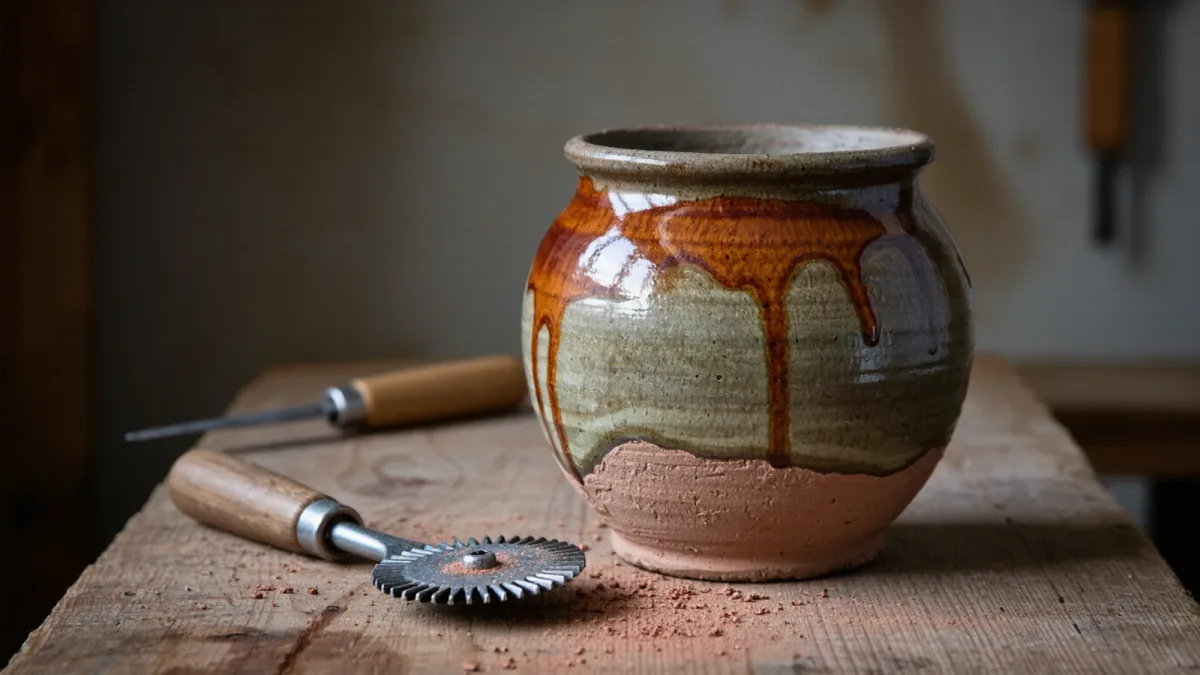
The potters of Mashiko, a small town in Tochigi Prefecture north of Tokyo, have been throwing stoneware from local clay since around 1853, when kilns were first built to supply the farmhouses around it with jars, pots, and sake flasks. What changed the town's history was not a market but a visitor: Shoji Hamada, already a known figure in the mingei folk-craft movement, settled in Mashiko in the 1920s and built his kilns there. When he was named among the first holders of the Living National Treasure title for ceramics in 1955, the world's attention arrived in a town that had been making pots, quietly, for a century.
Why did pottery take root in Mashiko at all?
Because the raw materials were all within walking distance. Mashiko sits on clay beds, and the surrounding hills supplied the silica and the firewood that climbing kilns consumed in quantity. The town's early output was strictly practical: storage jars for soy and miso, water vessels, grinding bowls, the brown-and-amber everyday stoneware that any farmhouse kitchen needed. Potters were farmers who threw in the slow months, and several of the old kiln families still describe their ancestry in exactly those terms, one season in the field and one at the wheel.
The geology explains the founding; the movement explains the fame. Yanagi Soetsu's mingei philosophy held that ordinary, useful objects made by unknown hands carried an honest beauty that court art had lost, and Mashiko's unpretentious ware became the movement's favorite example. Hamada chose the town partly for its clay and partly, his biographers suggest, for its ordinariness. He wanted to live where pots were made for neighbors, not museums.
What did Hamada's presence actually change?
It brought the world to a clay bed in Tochigi. Bernard Leach, the British potter who had worked with Hamada in Japan and England, visited and wrote about the town; apprentices arrived from Japan and abroad to work at Hamada's side; and by the 1960s Mashiko housed dozens of independent potters who had come for the clay and stayed for the company. The town absorbed them the way it absorbed everything, practically. Land was rented, kilns were shared, and a visitor in the 1970s could watch a second-generation jar maker and a young American apprentice firing on the same hillside.
Hamada himself worked at his wheel into old age, and his house and workshops are preserved as a museum today, the rooms kept as he left them. The measure of his influence, though, is not the museum. It is the town's current population of working potters, counted in the hundreds by the town's own craft association, a number no comparable town of its size in Japan approaches.
Related stories: The villages that bank hours instead of money · The seanchai's chair by the pub fire.
What is Mashiko like to visit now?
It is a working town, not an open-air museum, and the distinction matters to the people who live there. Kilns line the roads between fields; a visitor can walk from a shoji-screened gallery of tea vessels to a workshop where ten thousand rice bowls come out of gas kilns for department store orders. Twice a year, in spring and autumn, the Mashiko pottery fair, held since 1966, fills the streets with stalls and tens of thousands of buyers, and the town's population briefly multiplies. Locals describe the fair as the moment the year's work changes hands, not as a festival added on top of it.
Between fairs the pace is agricultural. The climbing kilns are fired a few times a year, each firing taking days of stoking around the clock. Wood-fired work here carries ash deposit and flame color that gas cannot imitate, and the potters' conversations about it are technical rather than mystical: stacking patterns, ember fall, where a kiln's flame runs hot. Eavesdrop in any of the workshops' shops and you will hear exactly that, not philosophy.
The kiln families and the newcomers divide the town's labor without much ceremony. Some of the old workshops fire shopped-out versions of the original farm jars for restaurants and department stores, keeping bulk orders flowing between fair seasons; the younger studios make one-off tea vessels for the gallery market in Tokyo and, increasingly, for overseas buyers who discovered the town through Hamada's reputation. Both economies burn the same clay, and each covers for the other in hard years. Potters who moved from the city describe the arrangement as the thing that surprised them most: not the beauty of the town, which is ordinary, but the completeness of an economy where making, selling, and living in one place have stayed the same job.
How does the town handle being a craft destination?
Carefully, and with a division the residents maintain politely. There is Mashiko as marketplace, which welcomes buses and bargain hunters at fair time, and there is Mashiko as workplace, which answers questions across a wheel and would rather show a glaze bucket than a slogan. The etiquette for a visitor follows from the division: buy from the people who made what you carry home, ask before entering any studio that is not signed as a shop, and understand that a potter who declines to chat mid-throw is not being unfriendly. The work has always been the point of the town.
The deepest fact about Mashiko is continuity under modesty. The town never became a ruin revived for tourists or a district rebranded by developers; it simply never stopped making pots, from the 1853 kilns through the Hamada years to the young potters renting former chicken coops for studios now. The jars on the shelves have changed less than the country around them. That steadiness is what visitors come to stand inside, whether they can name it or not.