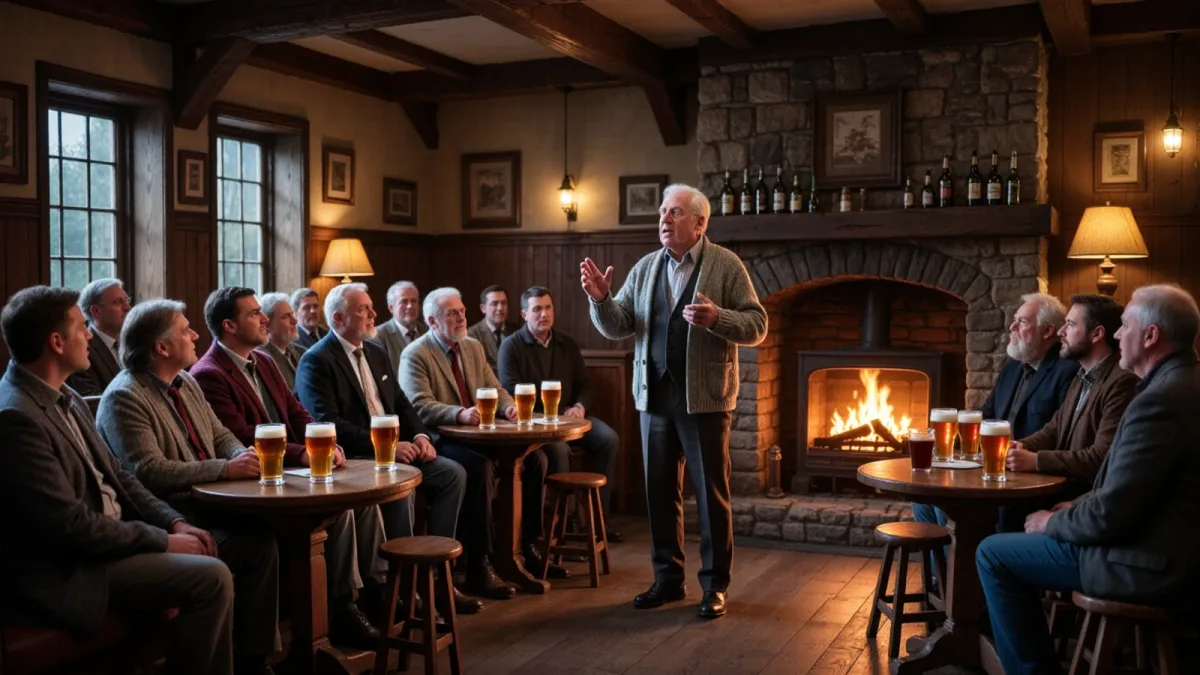
The seanchai was the person a community trusted with its stories, and the pubs where their successors work are the last public rooms that job has. In the old order, a seanchai visited houses in the evening, took the fireside chair that was understood to be theirs, and held the room for hours with tales of the Fianna, local history, and the kind of comic exaggeration Irish writing calls blarney only when it is being fond. The pubs of today that program storytelling nights, in Listowel and county towns across Kerry and Clare, are not reviving a lost custom. They are the current address of one that moved indoors.
What did a seanchai actually do?
Carried the community's memory in performance. The word itself comes from seanchas, old lore, and the seanchai's stock was correspondingly mixed: long heroic tales learned from other seanchaithe, genealogies, place-name explanations, songs, and the short sharp comic story that could be told between customers. Performance was governed by conventions recorded by folklorists: the audience answered, corrected, and demanded encores; a good tale stretched or shortened to fit the night; and the teller who finished before the room was ready had misjudged everything.
The craft was endangered and then documented in the same generation. In 1937 and 1938 the Irish Folklore Commission organized the Schools' Collection, in which schoolchildren were sent to write down stories and beliefs from their own grandparents and neighbors, producing hundreds of thousands of manuscript pages now held in the National Folklore Collection. The exercise saved material that the seanchaithe of the time still carried, and it fixed in writing a tradition whose natural home had always been the evening room with a fire in it.
Individual names anchor the tradition in the record. Peig Sayers of the Great Blasket Island, born in 1873, was recognized in her lifetime as one of the finest seanchaithe in Irish, and the autobiography she dictated, published in 1936, became one of the language's most read books, with her repertoire preserved in the folklore archives partly through the schoolchildren and scholars who visited her. Eamon Kelly of County Kerry, born in 1914, carried the repertoire onto the professional stage in the second half of the century, performing stories in the traditional manner to theatre audiences who had never sat at a fireside, and in doing so taught a national audience that the tradition was craft rather than quaintness.
How did the pub take over the fireside's work?
Gradually, and for practical reasons. As rural Ireland electrified and radio arrived, the house visit faded as an institution; the public house was the one room left where an audience assembled itself nightly without an invitation. Towns with strong literary cultures made the transition deliberately. Listowel in north Kerry, which produced the playwright John B. Keane and the writer Bryan MacMahon, both publicans, became the model: a pub where the owner wrote plays and the back room hosted whatever the town wanted to hear said aloud.
That model spread less as a format than as a habit. Today's storytelling sessions vary from town to town: a scheduled night with invited tellers, a festival week that pulls in seanchaithe from several counties, or simply a bar counter on a slow evening where an elderly customer begins a story and the publican has the sense to let it run. What the good sessions share is the old economics. Nobody is quite performing and nobody is quite a stranger, and the tale that works is the one the room can answer back to.
What should a visitor understand about a session?
That listening is participation. The conventions of the fireside survive in the pub: a story in progress is not interrupted for a round; laughter at the wrong moment is forgiven, correction is not; and the teller's winding approach to the point is the point. A visitor who asks a teller afterward where a story came from will usually get a genealogy of it, this house from that one, a version heard in a field camp in England, a line that belonged to a grandfather. The stories are owned in exactly that loose communal way, and the ownership is why they survive.
Buying the teller a drink remains the correct fee, in pubs where no fee exists. Some festival events now ticket their headline sessions, which the tradition absorbs without complaint; the fireside never required poverty, only attention.
The apprenticeship question is the one folklorists watch. In the fireside era a young teller learned by hearing the same tales many times from many mouths, absorbing structure and delivery without formal instruction; the modern equivalents are residencies, festival workshops, and simply long attendance at sessions, and the tellers who emerge from all three sound recognizably like the archival recordings. Language loss has changed the material, since many of the old tales were collected in Irish and are now performed in English, but the form, the long approach, the repeated three, the perfect closing line, has proven more durable than any single language it was told in.
Is the tradition actually continuing?
Measured by the evidence, yes, with a changed center of gravity. The National Folklore Collection's digitized archives let a listener hear recorded seanchaithe of the 1940s and 1950s, and county arts offices fund storytelling residencies and school programs that keep the apprenticeship alive. What has thinned is the old full-time profession: the person who told nightly in a district and lived on its welcome. What has thickened is the amateur and semi-professional layer around the pubs and festivals, where the audience itself supplies tellers.
A visitor who spends a week in Kerry and hears three good stories in three different rooms has encountered the tradition more accurately than any archive allows. The seanchai's chair still exists; it is simply whichever chair, in whichever pub, the best story in the room is being told from.