
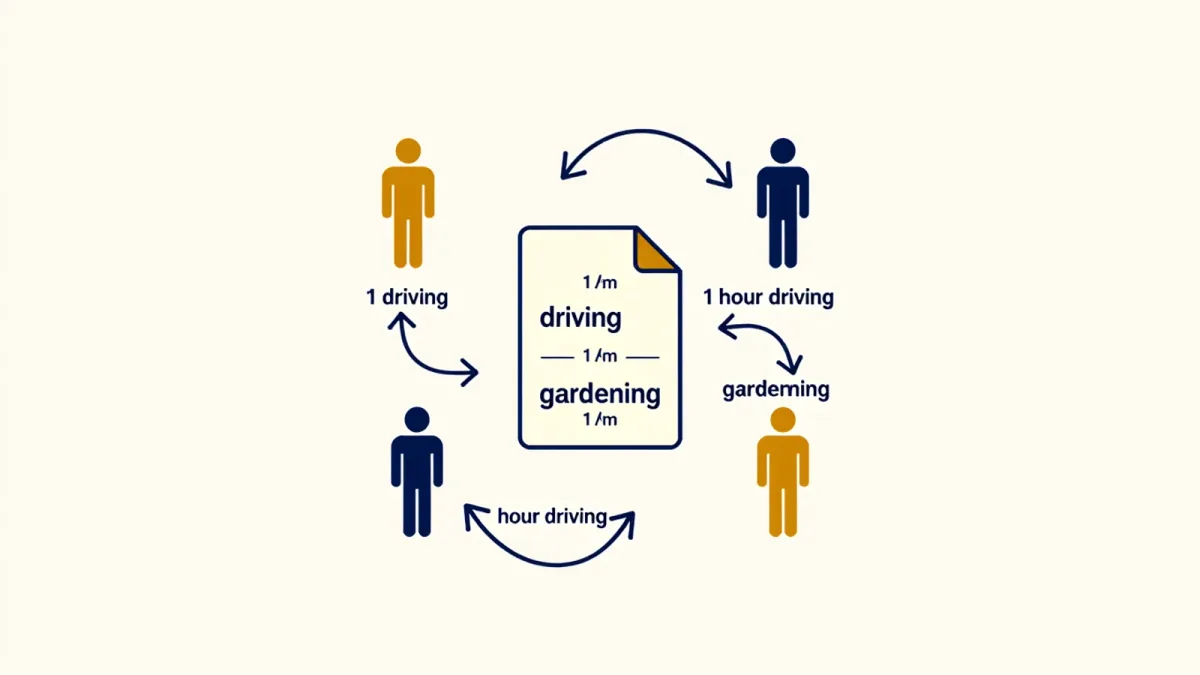
The time bank is a village economy written in hours. Members earn one credit for one hour of helping another member, driving to a clinic, mending a roof, sitting with someone's mother, and spend the credit on anyone else's hour, with no money changing hands and no exchange rate. The idea was formalized by the American law professor Edgar Cahn in the 1980s, who called his version Time Dollars, and it has since taken root most durably in exactly the places visitors find charming and statisticians find depopulating: small towns with more need than payroll.
How does a time bank actually work?
Through a ledger, kept nowadays by software and formerly by a coordinator with a notebook. Every member's hour is recorded equally, whatever the task: the lawyer's hour of advice and the plumber's hour of pipes are identical currency, which is Cahn's core design principle and the reason the systems attract people priced out of conventional mutual aid. A coordinator matches requests to offers, the ledger tallies who stands where, and negative balances are tolerated without interest, on the theory that a member temporarily in deficit is simply someone who will help later.
The model's simplicity hides its discipline. Time banks publish rules against hoarding and favor-trading, hold regular member meetings, and rely on the coordinator's social knowledge as much as the database. Members describe the psychology precisely: paying a stranger in hours removes the embarrassment of needing help, because the ledger converts a favor, which people refuse when they feel poor, into an exchange, which they accept.
Where did the idea spread first?
Japan and Italy gave it the rural applications it is now known for. Japan's Fureai Kippu, founded in 1991, applies the hour-credit idea to elder care, with volunteers earning credits caring for the elderly that they can spend on care for their own parents, sometimes in another prefecture, an arrangement that suits a country where adult children often live far from aging parents. Italy's banche del tempo multiplied through the 1990s into the hundreds, with municipalities and parishes sponsoring them as instruments of community policy rather than charity.
The fit with rural depopulation is structural. A village that has lost its bus line, its post office, and half its young families cannot restore them from local cash income, but it still contains enormous unused capacity: retired drivers, handy farmers, strong backs, and hours. A time bank prices that capacity at face value and puts it to work. Observers of the shrinking regions of southern Europe, from the Spanish interior to the Italian mountain comuni, have documented time banks functioning as a substitute layer of public services, arranged by neighbors where the state no longer arrives.
Real examples show the range better than the theory. Rural banks in the mountainous interior of northern Spain coordinate hospital runs that the regional bus timetable abandoned, booking drivers against a whiteboard of appointments; a bank in a depopulating comune in the Italian Apennines runs its village bakery day on member hours, with pensioners doing the kneading and teenagers, whose hours can be credited against school-community requirements, handling delivery by bicycle. Japanese Fureai Kippu branches publish accounts of members banking care hours at seventy for withdrawal at eighty-five, a form of pension the state pension office neither administers nor forbids. None of these projects uses the word revolutionary. All of them keep a book, and the books balance.
Related stories: The seanchai's chair by the pub fire · In Mashiko the wheel never stopped.
What has the movement learned in forty years?
That the currency is the easy part and the community is the work. Cahn himself argued in his later writing that time banks succeed where someone, usually a paid or semi-paid coordinator, treats membership-building as the actual job, recruiting through churches, clinics, and schools until the network contains both the people who need help and the people who will eventually need to give it. Programs that skip that step tend to plateau with a ledger full of unspent hours, which is the time bank's version of money rotting under a mattress.
The second lesson is that time banking changes what outsiders see. A visitor who spends a week in a village with an active bank will notice the rides being given, the meals appearing, the verges being cut, and will read them as neighborliness, which they are; the ledger underneath simply makes the neighborliness reliable at scale. Some rural time banks now list a community garden, a tool library, or a weekly collective meal among their standing projects, run on accumulated hours.
The traveler's own economy sits adjacent to this one and worth comparing. Tourism, particularly the slow variety, tends to treat a village as a place where services exist to be consumed, and the time-bank villages quietly disagree: they are places where services exist because residents make them exist, hour by hour. The respectful visitor's arithmetic adjusts accordingly. Money spent at the village shop supports the shop; time spent joining, honestly and briefly, in the bank's working afternoon supports the thing the shop is actually part of, and teaches more about the place than any purchase does.
Can a traveler engage with one?
Carefully, and often yes. Time banks hold open meetings, publish newsletters, and in several European towns maintain small visitor-facing projects, a café day, a guided history walk, staffed by members and open to outsiders, with hours credited to the volunteer's account or donated to the bank's community pot. The etiquette is the members' own: sign up through the coordinator, accept that an hour is an hour regardless of one's professional rate at home, and understand that the point of the afternoon was never efficiency. It was the demonstration, in a small economy, that everyone has something the day needs.