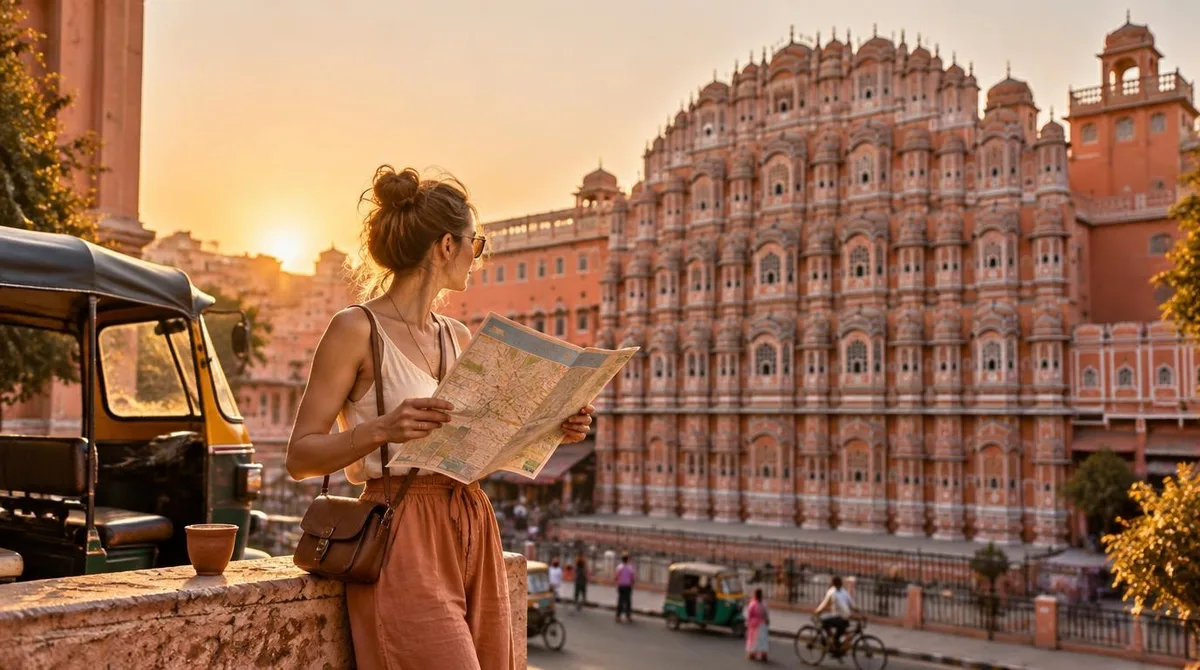
The honest version of solo female travel tips begins not with a packing list but with a habit of mind: women plan a trip and a backup plan for the trip. That is how one recent account of Indian women traveling alone puts it, and it captures what most generic advice misses. The preparation is doubled because the vigilance is doubled — the hotel reviews read twice, the live location shared with two people, the flight chosen for a daylight landing.
Yet the same women keep going, and for reasons that have nothing to do with bravery as a performance. A solo trip is the rare stretch of days when no one else's schedule applies. You eat when you want, sleep when you want, and discover that catching the right bus in an unfamiliar city can feel like a genuine achievement. The confidence is not a mood. It is built from small, verifiable wins.
This piece gathers what experienced solo female travelers actually report doing — how they prepare, what they carry, how they read a place on arrival — and what the wider data says about where the risks concentrate. The scale is worth knowing before the tips: according to Yahoo Travel, the risk firm Safeture reports that female solo travel grew by more than 60 percent over three years and now accounts for 71 percent of all solo trips worldwide. Most of those trips go well. The advice below is about making sure yours is among them.
Why does the mental load fall on women who travel alone?
Before departure, the work is research. Women writing about their own solo trips describe reading hotel reviews again and again, specifically looking for what other women said about safety, then picking flights that land in daylight and sharing their location with two people at home. The checking does not stop on arrival. Is this lane too empty? Is the cab number saved? Each question is small. Together, they are tiring in a way that men traveling alone rarely describe.
There is also the judgement at home. Women report relatives asking why they cannot take a friend, why they would spend their leave on a trip, why they will not simply wait until after marriage. The useful reframe, offered by the same writers, is that most parents are not opposing the plan. They are scared for you, and it is hard to argue with fear. Sharing hotel details and travel timings is framed less as a concession than as a way of keeping everyone calm, including yourself.
None of this means the trip is a battle. It means the trip carries a second, invisible itinerary — the safety plan running alongside the fun one. Naming that openly is the first tip, because a traveler who budgets energy for the checking will not be surprised by it.
How should a first solo trip be chosen?
The consistent advice is to start small and near. Women who have done it recommend a first trip of about two days to a place roughly three or four hours from home — not a long-haul itinerary as a debut. Book a stay with good reviews from other women travelers, which makes the room feel safer and more comfortable before anything else happens. Plan to arrive before dark, so there is time to settle in and get the lay of the land in daylight.
Keep the days light. Plan one or two things and leave the rest open, which is a philosophy this publication has argued for elsewhere in The plotted route and the wander are different kinds of knowing — the fixed plan and the free wander serve different purposes, and a first solo trip needs more of the second. One deliberate stretch is recommended above all: do at least one thing alone that feels slightly uncomfortable, such as eating at a restaurant by yourself. The first ten minutes feel strange. After that, it becomes normal, and it is the memory that tends to last. For related coverage, see The plotted route and the wander are different kinds of knowing.
What belongs in the bag?
The packing list for a solo woman is a list of contingencies. A power bank comes first, because a dead phone in a new city is the last thing you want. Alongside it: a printed copy of your ID and hotel booking, and a few emergency numbers written on paper, in case the phone gives up entirely. A small door stopper or portable lock adds a layer of reassurance in a hotel room at night. A basic first-aid kit covers painkillers, bandages and any regular medicines.
Smaller items earn their place by versatility. A stole or scarf serves dusty roads, cold buses and temple visits alike. Some cash goes in a separate pocket, because cards and mobile payments do not always work in smaller towns. Pepper spray is sometimes suggested, but the advice is to check airline rules before flying with it. And before stepping out each day, share your live location and booking details with one person back home.
Where do the real risks concentrate?
Most solo trips by women go well, and the growing numbers say as much. But the risk is not evenly spread, and it helps to know where it clusters. According to Yahoo Travel, rankings built on the Georgetown Institute's Women, Peace and Security Index for 2025/26 — which scores 181 countries on women's wellbeing across inclusion, justice and security — place Afghanistan last at roughly 0.28 against Denmark's leading 0.94, with Yemen, the Central African Republic, Syria, Sudan, Haiti, the Democratic Republic of the Congo, Burundi and South Sudan close behind. The index measures women's status rather than tourist crime, so it works as a proxy for risk, not a count of incidents involving visitors.
The practical takeaway is unglamorous: check current official advisories before choosing a destination, and understand that in some places consular help barely exists. A country under a Level 4 do-not-travel advisory, or one where an embassy has no functioning presence, is not a destination that planning can offset. Choosing where to go is the first and largest safety decision; everything on the packing list is downstream of it.
What this means for the trip you are already imagining
Put the pieces together and a pattern emerges. The preparation is real but finite: a near destination, a daylight arrival, a stay vetted by other women, a bag built for contingencies, one person at home holding your details. The discomfort is real but brief — ten minutes at a table for one, and then it is simply dinner. The confidence arrives not as a personality change but as an accumulation: the right bus caught, the stranger spoken to without hesitation, the small win noticed and kept.
What remains unknown is the part no list can settle — how a particular place will feel to a particular woman on a particular evening. That is why the women who do this most often trade notes rather than verdicts, and why the most useful thing a first-time traveler can read is another woman's honest account of what tired her out and what she would repeat. The stories, in the end, are the transferable part. A trip taken this way gives you stories, and stories are what last once the tan fades — a point made at length in Stories: Why the travel story outlasts the checklist. Start with the weekend near home. The rest, as the experienced travelers put it, you will figure out on your own.