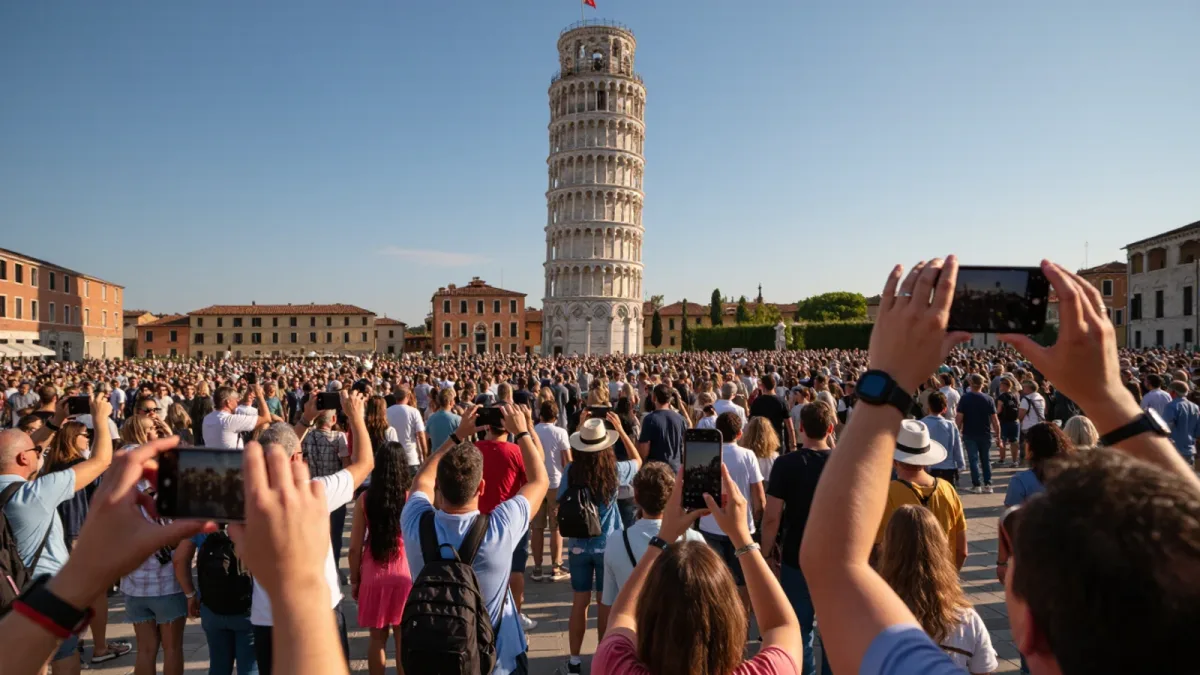
At the base of nearly every celebrated monument on earth, the same choreography repeats: a visitor raises a phone, holds it steady for two or three seconds, lowers it, and moves on. The gesture is so universal it has become part of the architecture. Susan Sontag observed the habit half a century ago in "On Photography" (1977), describing the camera as a device for converting experience into an image — something that can be carried off and looked at later. Half a century of additional evidence, from psychology labs and from the plaza itself, suggests the gesture is stranger and more interesting than either its critics or its defenders usually admit.
The charge against the lens
The standard critique writes itself. The photographer, it goes, is not present; the phone is a partition; the traveler collects proof of attendance instead of experience. Sontag's version was harsher still: tourism and photography, she argued, are bound together, each validating the other, until a trips becomes a program of subjects to be shot. The critique has real teeth in one specific place. In a widely cited 2013 study, psychologist Linda Henkel of Fairfield University found that museum visitors who photographed objects remembered them less well, in detail and in identity, than visitors who simply looked — the "photo-taking impairment effect," published in Psychological Science. When people zoomed in on a detail of an object, however, memory for the whole object was preserved, as if the act of composing restored the attention that point-and-shooting surrendered.
That finding is usually summarized as "cameras make you forget." The more careful reading is subtler: the damage happens when photographing replaces looking. The frame is not the problem; the unexamined snap is.
Why the gesture persists anyway
Dismissing the landmark photo as vanity misses most of what it does. Consider the plausible functions, each documented in travel behavior and memory research rather than in moralizing. A photograph is a memory prosthetic: Henkel's later work and the broader literature on reminiscence photography show that images people revisit do anchor autobiographical memory, even when the taking of them cost some fidelity in the moment. A photograph is also a social instrument — proof to a distant audience, a shared artifact with the person standing next to you, a request for someone to take one of the two of you together. And a photograph, finally, is a claim of arrival: written into the family album, the monument stop becomes an event that officially happened.
None of this requires the photographer to be shallow. The ritual at the Taj Mahal or the Gateway Arch runs on much older machinery than the smartphone: pilgrims have always carried something back — a medal, a stamped credential, a pressed flower. The photograph is simply the relic this century has standardized, infinitely reproducible and therefore, perhaps, lighter in meaning per unit. But the impulse it serves — to certify contact with a place — predates the lens by centuries.
What the research actually recommends
If the question is practical — how to keep the photo without losing the memory — the Henkel line of research offers two usable instructions. First, delay. In her team's follow-up work, the memory cost of photographing largely disappeared when people expected to revisit their images and did so thoughtfully; the photo is not the thief, the forgetting is. Second, compose. The zoom manipulation matters because it forces a decision about what the thing is: the whole facade, the keystone, the tour group blocking the door. A photograph taken after ten seconds of looking — deciding what detail carries the memory — behaves, in the research, like a form of looking rather than a substitute for it.
The landmark's side of the bargain
There is one more party in this transaction: the monument itself. Great landmarks are engineered, in a literal sense, for photography. The Eiffel Tower's scale was calibrated to be legible from across a city; Haussmann's boulevards laid sightlines toward it long before anyone imagined a phone. The sites that collect crowds are the ones whose geometry survives reproduction — whose identity is not destroyed by being flattened into two dimensions and shared a billion times. In that sense the landmark photo is not a failure of travel but a collaboration with the place. The tower wants to be photographed; it was designed to be. What the traveler does with the seconds after the shutter — whether anything of the visit survives outside the file — is the only part of the ritual that is genuinely up for grabs.
The honest position, then, is neither the influencer's nor the scold's. Take the photograph; take it deliberately; look first. The plaza will still be there when the phone is down, and the difference between a traveler who photographed a landmark and one who merely documented attendance is measured in exactly those seconds of attention the research says matter most. Sontag warned that the camera's ease threatens to convert the world into a series of images. The remedy she implied is the same one the memory labs reached fifty years later: photograph the way an attentive person looks — after, and not instead.
Two registers hiding in one gesture
It helps to notice that the landmark photograph is really two different documents wearing the same gesture. The first is the private register: the slightly crooked shot with a partner's head in the corner, worthless as an image and priceless as a cue, kept for decades and revisited exactly the way the reminiscence research says memory thrives on. The second is the public register: the clean, uninhabited, postcard-correct frame posted for strangers, in which the photographer appears only as skill. The first register survives because it points at a relationship; the second because it points at competence. Most of the cultural irritation around landmark photography — the eye-rolling at the crowd, the vague guilt — is a reaction to the second register performed too earnestly, the sense of a person standing before one of the wonders of the world and producing something a stock library already holds in forty versions.
But the two registers bleed into each other, and the bleeding is where travel actually lives. A composition attempted honestly — waiting for the light to move off the facade, crouching to catch the reflection in a wet cobblestone, letting the school group stay in the shot because the school group is also true — converts the public image back into a private act of attention. The camera becomes an excuse to stay longer, which is the entire gift a landmark has to offer anyone who arrived with a phone.
The older counter-rituals
Travelers who distrust the lens are also following an old script. The sketchbook tradition runs at least from the Grand Tour through Edward Lear, whose illustrated travel journals of the 1840s turned drawing into a discipline of staying; the hand-drawn view takes an hour the photograph takes three seconds, and the hour is the point. The written journal does the same work in prose. What the counter-rituals share with the well-composed photograph is a costly signal: they spend time, and attention follows the spending. Researchers of event memory would recognize the mechanism immediately — elaboration, the act of processing an experience into another form, is among the oldest memory aids known to psychology. A sketch is elaboration; a considered photograph, with its ten seconds of framing decisions, is a modest sketch. An unexamined snap is not.
None of this argues for putting the phone away at the monument gate. It argues for choosing, at each stop, which register the image belongs to and paying the corresponding price: either the two honest seconds of the private snapshot, kept for its cue rather than its quality, or the ten deliberate ones of an image actually composed. What cannot be done, if the memory research and the older traditions agree on anything, is nothing — the default setting, the raised arm, the automatic capture that documents the visit without admitting it. The landmark will tolerate almost anything except that. It has stood for centuries waiting to be seen; three seconds of looking first is not much to ask in return.