
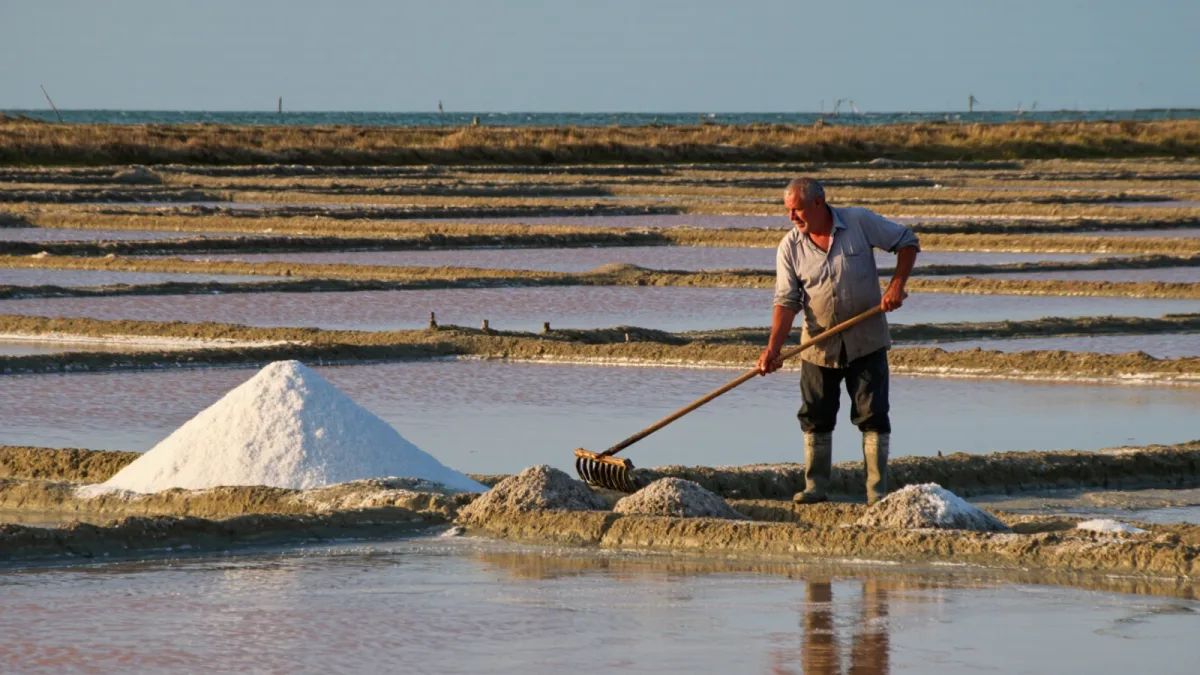
The paludiers of Guerande, the salt harvesters of the peninsula's great marshes, work a landscape that has barely changed its logic in a thousand years. Salt has been gathered on the Atlantic side of the Guerande peninsula since at least the early medieval period, and the marshes' present arrangement, a staircase of clay basins in which seawater climbs by gravity and evaporates toward purity, descends from plans documented in the Middle Ages. Around four hundred paludiers work the pans today, per the producers' own counts, harvesting fleur de sel and grey salt by hand in a trade organized, unusually for a modern economy, as a cooperative of independent workers.
How does a medieval salt marsh still function?
Through gravity, clay, and rules. Seawater enters the marsh through fixed channels at high tide, rests in the great basin to shed its sediment, and then moves through a descending series of shallow ponds, each smaller and saltier than the last, until it reaches the œillet, the final clay basin where the salt crystallizes. The paludier's tools are the lousse, a wide wooden rake with a mesh bottom, and the ladle for the day's fleur de sel, the fragile white crystals that form on the surface on dry, windy afternoons and must be taken off before they sink. Nothing is mechanized. A mechanism would scrape up the clay that gives grey salt its color and its mineral taste.
The social engineering is as old as the hydraulic. The marshes are held and worked under a collective regime of rules, boundaries, and water-sharing that predates the modern state, administered by the trade's own institutions and by a syndicate of owners and producers. Water is the contested resource: a paludier who takes too much, or drains too early, damages the neighbors' crystallization, which is why the marsh keeps its medieval governance rather than a free-for-all. Newcomers serve apprenticeships with established paludiers before holding their own pans.
Related stories: The salt that still leaves the mountain at Hallstatt · Who lights London's last gas lamps.
What is the harvest actually like?
Seasonal, weather-governed, and physical. The harvest runs from roughly June to September, and the paludier's year is the opposite: winter and spring are spent maintaining the clay, cutting the banks, repairing the basins by hand, work that the trade considers half the job and visitors never see. During the season the worker walks the pans daily, taking fleur de sel from the surface in dry weather and raking the heavier grey salt every few weeks, carrying it out in loads on shoulder and barrow. The producers' cooperative markets the crop, with the region's total harvest running in the thousands of tonnes in a good year, and prices the two salts apart, the fleur as the confectioner's product and the grey salt as the everyday one.
The weather risk is absolute. Rain dissolves a day's fleur de sel within minutes, and a wet summer can cut the harvest to a fraction. Paludiers describe the trade's economics honestly: nobody enters it to get rich, and the people who stay do so because the work suits them, outdoors, solitary but never isolated, inside a community that shares equipment, weather predictions, and a firm sense that the marsh comes first.
The trade's modern history is a case study in self-defense. Industrial salt from mines and vacuum plants undercut marsh salt on price through the twentieth century, and the Guerande harvesters answered by organizing rather than mechanizing: the producers formed their cooperative in 1979, secured a protected geographical indication for the region's salt, and built the market distinction, fleur de sel as a named, priced, hand-skimmed product, that lets a few hundred small harvesters sell into gourmet shops worldwide. Young people have taken up the trade in recent decades in numbers the older paludiers did not expect, trained through the apprenticeship system precisely because the cooperative made the economics survivable. The marsh's oldest rule, that the community's water discipline protects every member's harvest, turned out to be a modern competitive strategy wearing medieval clothes.
What should a visitor know about the marshes?
That they are a workplace and a hydraulic machine, not a beach. The paths between basins are the paludiers' roads, clay dikes a step wide; walking them out of curiosity can break a bank that took a day to repair, and wading in any basin disturbs the settling process the whole chain depends on. The right way in is on foot or by guided visit on the marked circuits, in the morning when the light is workable and the harvesters are at the pans, and to buy from the cooperatives' and producers' own shops, where the salt is the actual harvest rather than a repackaged import.
Respect has a specific shape here. The marshes' visual beauty, the geometry of basins turning gold and rose in the evening light, is a byproduct of a working system, and the paludiers' protectiveness is not hostility to visitors but the same instinct that keeps their water rules. Photograph from the paths, ask before photographing a person at work, and be suspicious of any product sold in the region as Guerande salt without a producer's name on it; the cooperative system exists partly so the label means something.
Why has this trade survived when mechanization everywhere else won?
Because the product and the method are inseparable. Hand-harvested fleur de sel cannot be produced by machine, the clay basins cannot be worked by vehicles, and the cooperative structure, which prices the paludier's skill into the salt, has held the trade together through the decades when cheaper industrial salt took every market it could. What remains at Guerande is rare in Europe: a medieval industry still owned by its workers, still governed by its own rules, still answering the oldest demand in commerce, salt, with the oldest method in trade, patience.