
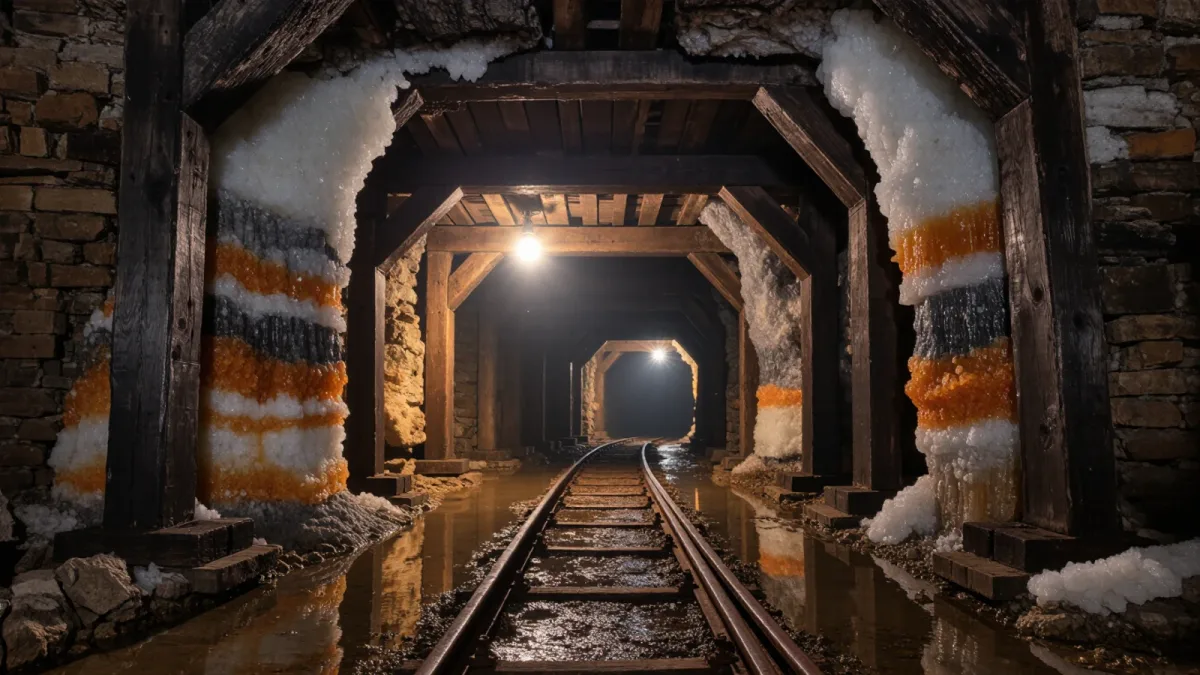
The miners of Hallstatt work the oldest industrial site in Europe. Salt has been extracted from the mountain above the lake village for roughly seven thousand years, on the evidence of the archaeological digs that keep finding older galleries, and the Iron Age culture of central Europe is literally named after the place: Hallstatt, in period terms, means the centuries around 800 to 450 BC, when the mountain's salt financed a society rich enough to fill its graves with amber, ivory, and bronze. The mining has never stopped. Salt still leaves the mountain, most of it as brine pumped through a pipeline to the works at Ebensee, a line first laid in 1607 and among the oldest industrial pipelines in continuous service anywhere.
Why was mountain salt worth so much?
Because it was rare, and everyone needed it. Before refrigeration, salt preserved food, and communities without access to the sea or to salt springs paid heavily for a dependable supply. Hallstatt's deposit sits inside the mountain as rock salt, reachable by galleries that Bronze Age miners cut with antler and bronze tools, and the underground conditions that make the mine difficult also preserved its evidence: leather, cloth, wooden handles, and the famous prehistoric mining boots survive in the galleries in conditions no surface site offers.
The economics built the village. Hallstatt's lakeside houses, its church on its promontory, its bone house, all of it is the architectural face of a salt income that ran, with interruptions and owners, from prehistory through the Habsburg salt administration to the present. The nearest comparable operation, at Bad Dürrnberg above Hallein a day's drive west, mined on the same logic from the Iron Age onward and closed in 1989; Hallstatt's mine remains in production, which makes the village the rare case where the museum and the industry share one mountain.
The archaeological record keeps deepening the story. Excavation campaigns on the mountain, led for decades by the Natural History Museum in Vienna, have pushed the dating of the earliest extraction further back with each campaign and recovered objects, a wooden carrying case, a leather cap, a bronze pick, that put individual prehistoric workers within touching distance. In 2019 researchers reported the recovery of preserved wood from the Bronze Age workings so fresh in condition that tool marks could be read directly. The mine, in other words, is not a finished story with a museum attached; it is a research site still producing firsts, which the villagers treat the way ports treat the tide, as the thing their town is for.
Related stories: The seanchai's chair by the pub fire · The salt fields of Guerande are still worked by hand.
Who were the miners, and how did they live?
As a hereditary professional caste with privileges to match the danger. The salt miners of the Salzkammergut formed closed brotherhoods, the knapschafts, that controlled entry to the trade, paid sick and burial funds from members' contributions, and enjoyed exemptions ordinary subjects did not, an elevated status recorded in Habsburg administrative papers. Their patron, St. Barbara, appears in the mine's chapels and banners, and the craft's rituals, the swearing-in of apprentices, the annual feast days, were the village's public calendar as much as the church's.
The work itself was brutal in specific ways. Miners slid down wooden ladders between levels, worked in wet and dust, and carried the salt or the ore of it on their backs up ladders cut into the rock. The prehistoric finds include the miners' equipment as well as their accidents, and the dig reports handle the topic with the flatness of science: men died underground in every period the mine has been opened. The brotherhoods' funds existed because the risk was a certainty distributed over time, and every miner's family held shares in it.
What does the site look like now?
Like a working mountain wearing its own museum. The Salzwelten operation runs guided visits into the historic galleries, high on the mountain above the village, where visitors descend the miners' slides and stand in chambers whose prehistoric timbering is left in place; the archaeologists' finds are exhibited in the museum in the village below. Above the tour route, the industrial mine continues its extraction, dissolving salt with water to make brine and sending it down the pipeline to Ebensee, where the works refine it. The village between the two, postcard-famous and often overcrowded at midday, is best understood as the miners' housing estate, which is historically exactly what it is.
Visitors who want the miners' rather than the tourist's Hallstatt should invert the day: walk the mountain in the morning before the coaches arrive, read the dig reports in the museum after, and end at the churchyard or the bone house, where the community's continuity is stated more plainly than any exhibition can. The skulls painted with flowers are the mine's own dead, kept and decorated by the families and brotherhoods that inherited the trade.
Why does the tradition matter beyond the village?
Because Hallstatt is where industrial history gets its dates. The archaeology of the mountain organized the European Iron Age into a named period, and the records of the early modern salt administration, wages, delivery books, the pipeline's construction accounts, are a rare continuous economic archive reaching back centuries. The living tradition, a mountain still paying a community for its salt after seven millennia, gives the archive a heartbeat few historical sites can match, and it is running while you read this, one more brine pump's turn at a time.