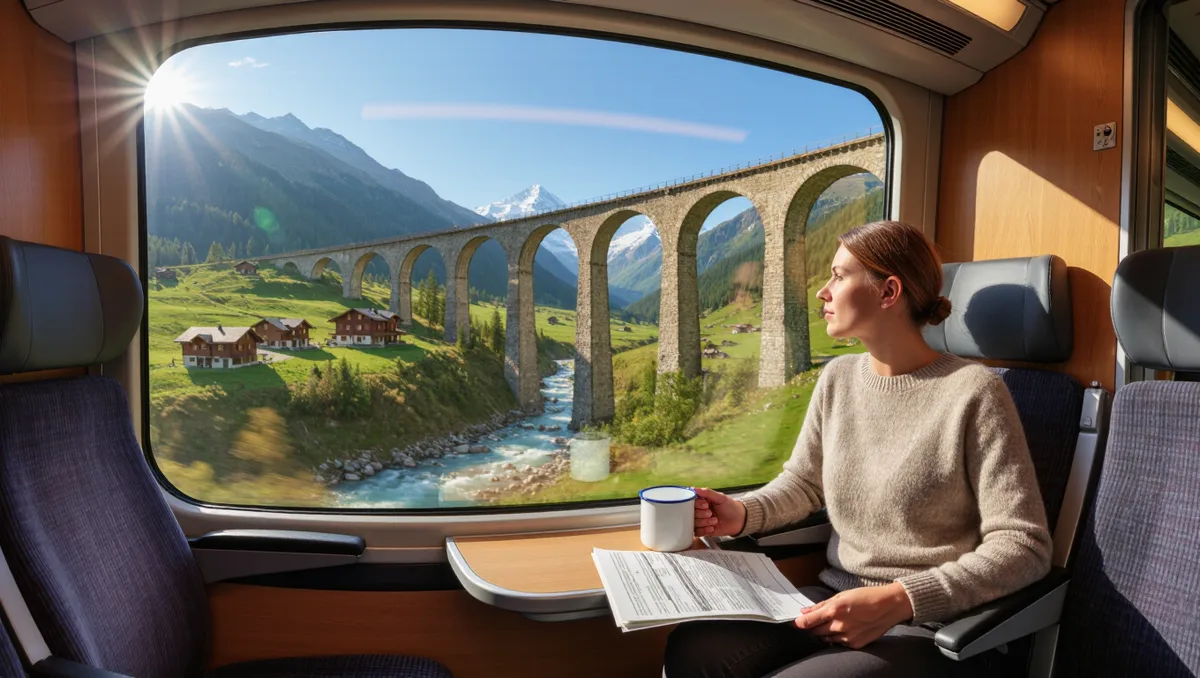
The best rail corridors in Europe are the ones where you stop checking the time. Not because the train is late, but because the view has taken over the job. Slow travel through Europe by rail is less about a single famous line and more about choosing corridors where the journey genuinely outshines the destination, and then giving them the hours they ask for.
The word itself does some quiet work here. According to Cambridge Dictionary, its synonym tables offer "unhurried" and "leisurely" as the gentler cousins of the word. Dictionary.com, meanwhile, defines slow as moving or proceeding "with little or less than usual speed or velocity," and records a modern compound for exactly this habit, "slow tourism," described as leisurely exploring a place, soaking in nature, and savoring local encounters. That is the register this piece is written in: not sluggish, not behind schedule, just deliberately unhurried.
What follows is a ranking in the loosest sense. These are corridors where the ride is the point, ordered by how fully the window justifies the ticket. No trip in this piece was taken by the author for reporting purposes; this is a synthesis of what rail travelers widely prize, written as a planning companion rather than a memoir.
What makes a rail corridor worth savoring?
Three things, and they are easy to check before you book. First, the line should follow terrain rather than cut through it: rivers, valleys, coastlines, mountain passes. Railways built for scenery curve where the land curves. Second, the train should be slow in kind, not just in speed. A regional train with doors that open at small stations gives you a different Europe than a high-speed service sealed behind glass. Third, the corridor should reward stopping. A great slow rail route strings together towns where getting off is not a detour but the design.
Our analysis is simple: a corridor earns its place when you would gladly ride it again with the destination deleted from the itinerary. That is a stricter test than it sounds. Many famous lines are famous for what waits at the end. The ones below pass the stricter test.
Which corridors belong at the top of the list?
The Alpine crossings come first, and among them the routes through Switzerland and western Austria stand out. The appeal is structural. The line climbs through valleys where villages sit close enough to read the church spires, tunnels alternate with open ridgelines, and the gradient itself slows everything down. You are not watching scenery flash past; you are being carried through it at the pace of the mountain.
Next, the river valleys. The stretch of the Rhine between Mainz and Koblenz in Germany is the classic: castle after castle on both banks, terraced vineyards, barges pushing upstream. The Danube between Vienna and Budapest trades castles for wide water and floodplain forest, and it ends in a capital worth a week on its own. River corridors have a built-in narrative. The water goes where the water goes, and the train politely follows.
Then the coastal runs. Norway's lines north of the cities ride above fjords and over treeless plateaus, and the light in summer does half the work. In the Mediterranean, coastal stretches in Italy, Spain and southern France deliver the opposite palette: sea on one side, dry hills on the other, stations named for towns you have never heard of and will want to correct that.
Finally, the cross-border regional routes that nobody markets. A local train from Slovenia into Italy, or from Bavaria into Austria, or along the borderlands of central Europe, tends to be the cheapest and strangest ride available. Nobody on board is sightseeing. The corridor exists because people live there. That ordinariness is exactly what makes it slow travel.
How do you actually ride one of these slowly?
The mechanics matter more than the romance. A few practical steps, offered in general terms:
- Ride regional and stopping services where they exist. They are slower by design, and the doors open at places the expresses skip.
- Break the corridor into legs with overnight stops. A scenic line divided across three days is a different trip than the same line in one push.
- Book flexibly where fares allow, because slow travel means wanting to stop when a town looks interesting, not when the fare does.
- Sit on the correct side. On river routes, the water side; on coastal runs, the sea side. This is the single most reversible mistake in European rail.
Cost and pass mechanics are their own subject, and we cover the arithmetic elsewhere in What a rail pass actually saves you, and when it doesn't. The short version for this piece: a pass rewards many short rides, which is precisely what a corridor-by-corridor itinerary produces.
What should you skip?
Skip the temptation to collect famous lines. Six legendary routes raced through in a fortnight is fast travel wearing slow clothing. Skip the sector where the scenery is a two-hour highlight followed by four hours of freight yards and suburbia; every country has these, and the timetables do not warn you. And skip the assumption that the fastest available connection is the best one. On a corridor worth savoring, the slower train is not a compromise. It is the product.
One more thing to skip: the idea that a slow rail trip must be improvised. The unhurried version of this travel style is planned, then loosened. We walk through the planning side step by step in How to plan a slow travel trip, step by step, and the mindset behind it in What slow travel really means, and why it works.
Where does rail sit among Europe's slow options?
Rail is the middle register of European slowness. Walking is slower and more intimate; ferries are slower and stranger. We have argued separately that Europe's ferries are its slowest, most honest transport, and that Europe's regional trains reward the traveler who stops counting. Rail's advantage is range. A walker covers a valley in a day; a ferry covers a crossing. A train covers a country in an afternoon, with the scenery doing the narrating and your luggage doing nothing at all.
That range is why rail anchors so many slow itineraries on this site. Browse the wider slow travel collection for the other registers, from month-long stays to walking routes between towns.
What this means for your next ticket
The evidence of how travelers describe this style is thin but consistent: according to Dictionary.com, "slow" is characterized by lack of speed, and Cambridge Dictionary's synonym tables place "unhurried" among its kin, and that is the whole philosophy in two entries. Pick a corridor that follows water or climbs a mountain, ride the stopping train, get off where the spire looks interesting, and let the destination be whatever town you happen to sleep in. The ranking above is a starting map, not a verdict. The corridors that will matter most are the ones you ride with nowhere urgent to be.