
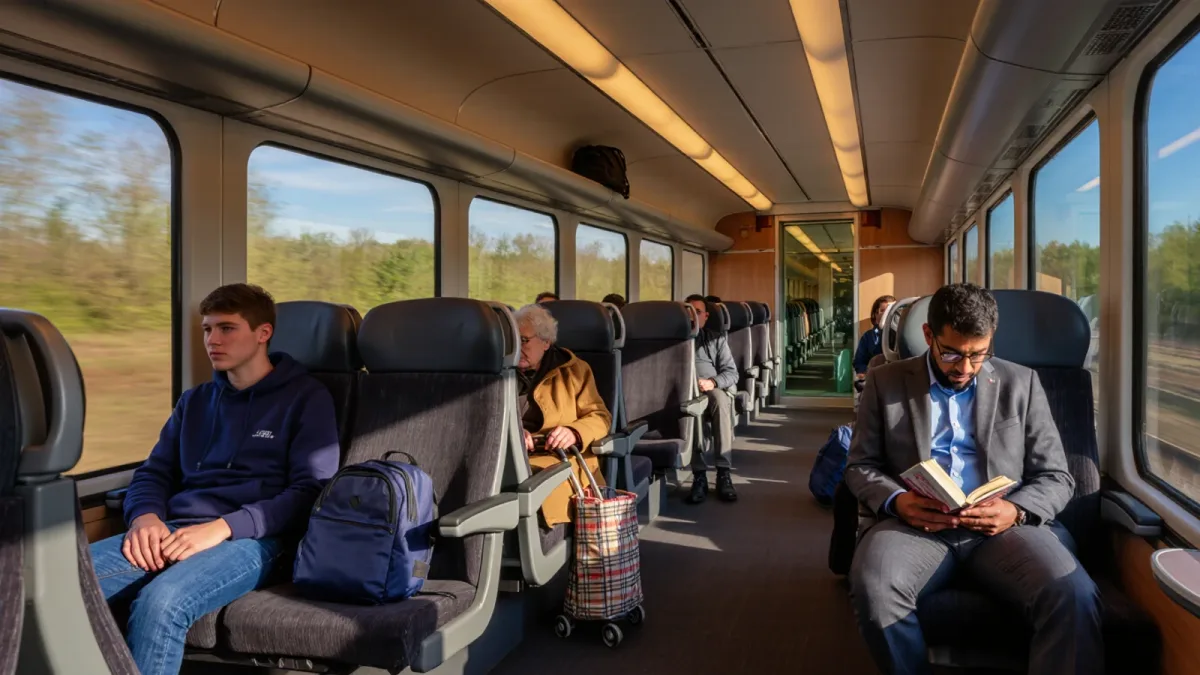
Europe's regional trains — the stopping services that call at every market town between the cities — are the continent's cheapest and most overlooked slow-travel instrument. Germany's Deutschland-Ticket, which covers unlimited travel on regional and local transport nationwide, costs €63 a month as of January 1, 2026, per Deutsche Bahn, up from €58 in 2025 and €49 at its 2023 launch. That is less than most high-speed tickets for a single city pair. This primer explains how to travel slowly and cheaply on Europe's regional rail network, and what the pace itself gives back.
A note on scope: fares, rules and rolling stock change, and this site publishes information, not travel or financial advice — verify current conditions with the operator before booking.
What counts as a regional train?
Across Europe the vocabulary differs — Regionalbahn and Regional-Express in Germany, TER in France, Regionale in Italy, Regio in Switzerland and Austria — but the pattern holds. Regional trains serve small and intermediate stations, rarely require seat reservations, and carry a flat or zone-based fare structure. They are the workhorses that move commuters, schoolchildren and shoppers, which is exactly why they show a traveler the country people actually live in rather than the corridor between two capitals.
How much slower is "slow," in numbers?
A high-speed service might cover Munich to Nuremberg in about an hour; a regional routing along the same corridor takes roughly twice as long with changes. Across a month, though, the arithmetic inverts. A monthly regional pass in Germany costs €63 from January 2026; a single flexible high-speed fare between two large German cities can approach that figure on its own. In Switzerland, a monthly all-zone pass for one canton or a regional travelcard prices out similarly against even a handful of long intercity trips. The regional traveler pays in hours and recovers the cost in itineraries that simply have no price at high speed.
How do you actually plan a regional-only trips?
Every national operator's trips planner — bahn.de in Germany, sncf-connect.com in France, trenitalia.com in Italy, sbb.ch in Switzerland — has a settings panel where you can exclude high-speed services, or set a maximum walking or transfer time. Plan in two directions at once: a corridor and a fallback. The regional web is dense enough that a missed connection rarely strands you for more than an hour, and the planner will usually reroute you through a town you would never have chosen. That is a feature. Treat the reroute as part of the itinerary.
Related stories: Europe's ferries are its slowest, most honest transport · The monthly math that makes slow travel cheaper than a vacation.
What does the pace give you that speed does not?
Three things, and they compound. First, granularity: a stopping train reveals the seams of a country — the freight yards, the monastery on the ridge, the town whose entire station calendar revolves around a morning fish market. Second, company: regional services are where a traveler actually meets residents, because residents are the clientele. Third, stamina: five hours in a regional carriage with a sandwich and a window teaches a kind of patience that no airport lounge replicates, and it resets the internal clock to the speed of the places outside.
Which corridors reward the regional-only treatment?
A few well-documented examples, none of them secrets. Germany's Mitteldeutsche routes through Thuringia string together UNESCO-listed classical towns on hourly regionals. Austria's line from Salzburg toward Graz, changing at Bischofshofen, runs through alpine valleys the Westbahn corridor bypasses. France's TER through the Auvergne, and Italy's slow push from Cuneo toward Ventimiglia over the Col di Tenda, are studies in how a timetable can double as a sightseeing document. In every case the same rule applies: buy the flat-rate or zone product, board without a reservation, and let the intermediate stations argue their case.
What should you pack and expect?
Regional carriages were built for commuters, not luggage: pack light, expect steps at the door, and check whether your service is operated by a small diesel unit with limited space for bicycles. Toilets are present but variable; food service is essentially nonexistent, so station kiosks and market halls become your restaurants — an upgrade, not a downgrade, in most regional capitals. Off-peak mid-morning and early-afternoon departures are emptiest. And keep the paper ticket or digital pass charged: inspectors on regional services are routine, and the fines for riding without a valid fare are steep everywhere.
The arithmetic of a month on regionals
Run the numbers for any one country and the slow option stops looking like a sacrifice. One Deutschland-Ticket at €63 (as of January 2026) plus four weeks of modest regional lodging — small towns price 30 to 50 percent below the capitals — can total less than a single long weekend built around high-speed tickets and city-center hotels. The travel press has covered the pass's political fights extensively; what it changes on the ground is simpler. The person who stops counting hours starts counting places, and the regional timetable, the least glamorous document in European transport, quietly becomes the best itinerary planner on the continent.