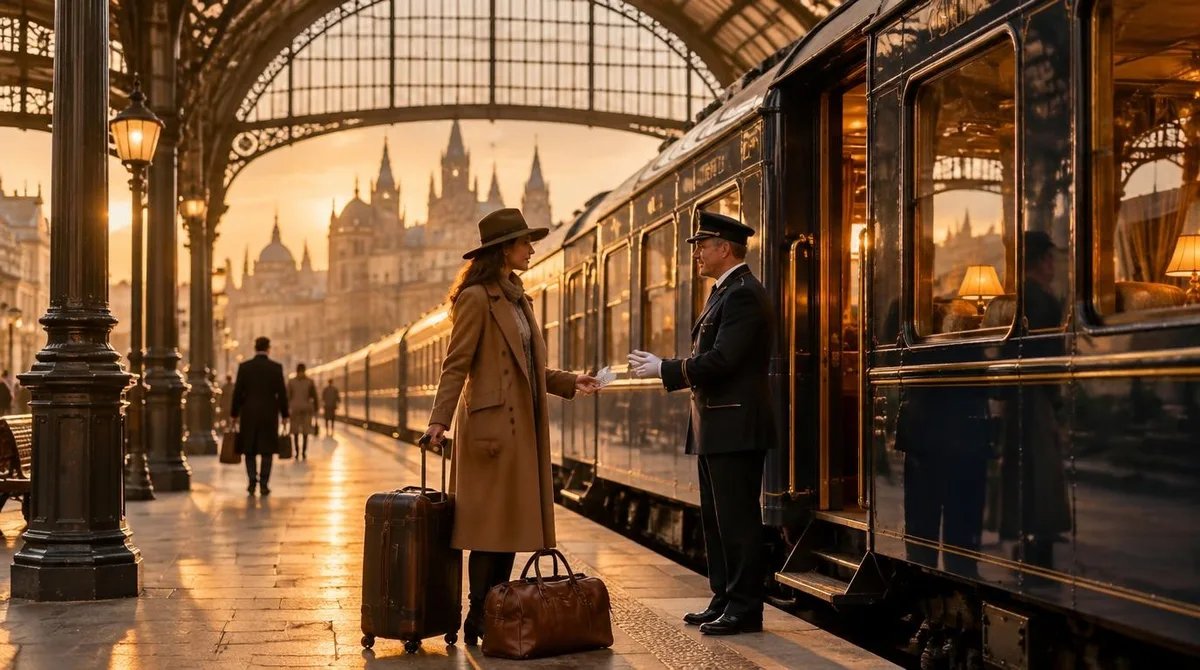
There is a scene that repeats across the brochures now. A small group stands at a market stall somewhere old and beautiful, and the caption says the travelers are going slowly. But the itinerary underneath it lists five towns in nine days, a morning departure every second day, and a coach with a name on the side. The word slow has become a label. The question worth asking is not whether a slow travel company uses the word, but whether the schedule underneath it has actually changed.
This piece is a way of answering that question before you pay a deposit. It sets out the checks that separate a genuine slow-travel outfitter from a conventional tour wearing new language, and it does so without naming names, because the pattern matters more than any single operator. The same checks work whether you are looking at a walking week in the Alps, a rail journey across a peninsula, or a month built around one market town. If you want the underlying idea first, our guide to what slow travel really means and why it works covers the ground in more depth. This connects to our earlier piece, Slow travel meaning: What slow travel really means, and why it works.
What does slow actually mean on a tour itinerary?
Start with the word itself. As Vocabulary.com defines it, slow describes things that do not move fast but take a while to get where they are going — and, as a verb, to reduce speed or intensity. That second sense is the useful one here. A slow trip is not merely a trip with long gaps; it is one where the pace has deliberately been reduced, and the reduction is visible in the itinerary's arithmetic.
The arithmetic is easy to run. Count the nights in each base. A genuine slow itinerary holds a base for several nights at a stretch, often a week or more, and radiates outward from it on day trips. A rebranded bus tour does the opposite: it moves the base almost nightly and calls the moving itself the experience. Count the number of distinct places too. If a nine-day itinerary lists five destinations, the average stay is under two nights, and no amount of language about immersion changes what the schedule is doing. The itinerary is a promise, and the promise is either one place, deeply, or many places, quickly. Very few operators can be both.
How can you tell a slow travel company from a rebranded bus tour?
Look at the transport before you look at the adjectives. The mode of travel tells you most of what you need to know. A company that has genuinely slowed down books you onto regional trains, ferries, and walking routes, because those are the modes that make slowness structural. The corridor-by-corridor way of crossing Europe by rail is a good example of what that looks like in practice: the journey is the itinerary, not the gap between items on it. A coach with a company logo, by contrast, moves a group fast precisely so the group can be managed. There is nothing wrong with that model. It is just not slow, whatever the brochure says. For related coverage, see Ferry routes: How to read a ferry timetable like a local.
Then look at the group and the guide. Slow travel, done honestly, tends toward small groups and local guides who live where the trip happens, because the point is depth in one place rather than coverage of many. A rebranded tour keeps the large coach, the tour manager who travels with the group, and the checklist of sights — and adds one long lunch or one free afternoon, then markets the free afternoon as slowness. Ask a direct question of any operator: how many nights does the group stay in the same bed? An honest answer is a number. A deflecting answer is a paragraph.
What should a genuine slow-travel itinerary include?
The reliable markers are unglamorous. They include:
- Few bases, long stays. One or two places for the whole trip, with the days built around them rather than around transfers.
- Ground transport. Trains, ferries, boats, and feet. If you want to see how ferry timetables themselves shape a slow route, our guide to reading a ferry timetable like a local is a useful companion.
- Free days that are actually free. Not optional excursions at extra cost, but days with no scheduled content at all, because unscheduled time is where a place becomes familiar.
- Local spending. Markets, neighborhood restaurants, and small operators, rather than a pipeline that routes every meal and ticket through the tour company.
- No hidden pace. The full daily schedule published up front, including departures, so the pace can be judged before booking.
Absence of these markers is the tell. The most common rebrand keeps the fast itinerary and swaps the vocabulary: coaches become vehicles, sightseeing becomes cultural immersion, and a single unscheduled afternoon becomes a signature slow moment. The schedule, not the vocabulary, is the evidence.
What does this mean for how you should book?
Our analysis is that the check is simpler than the marketing suggests: read the itinerary as a schedule, ignore the adjectives, and do the two counts. Nights per base, and number of distinct places. If the numbers say slow, the trip is slow regardless of what the operator calls it. If the numbers say fast, the word on the cover is decoration.
It is also worth deciding how much slowness you actually want to buy from a company at all, because a good deal of slow travel needs no outfitter. The step-by-step way to plan a slow trip on your own, the month-in-one-city method, and the discipline of staying a week in one place all produce the same depth an outfitter promises, at your own pace and usually for less money. Where a company genuinely earns its fee is in the logistics you cannot easily arrange yourself: a walking route that needs luggage transfers, a rail corridor that needs local knowledge, a region where a resident guide opens doors. Pay for that. Do not pay for the word slow.
One honest trade-off belongs in the ledger. Slow itineraries cost fewer transport segments but more nights, and they suit travelers who would rather know one town well than five towns briefly. If your actual preference is coverage — many places, efficiently — a well-run conventional tour may serve you better than a slow-branded one that keeps you on a coach while calling it immersion. Matching the trip to the traveler is part of doing this honestly, on both sides of the counter.
Where the slow travel company question goes from here
The label will keep spreading, because slow travel sells a feeling that mass-market tours have trouble manufacturing. That is not a reason for cynicism; it is a reason for reading schedules. The evidence that an operator means it will always sit in the same places: nights per base, ground transport, genuinely free days, and money that reaches the neighborhood. Check those, and the rebrands sort themselves out.
What remains unknown is how long the word holds its meaning before it wears thin entirely. Words in travel marketing erode under use. The travelers who keep slow travel honest are the ones who keep asking the schedule to match the language — and who, when it does not, simply book the train themselves.