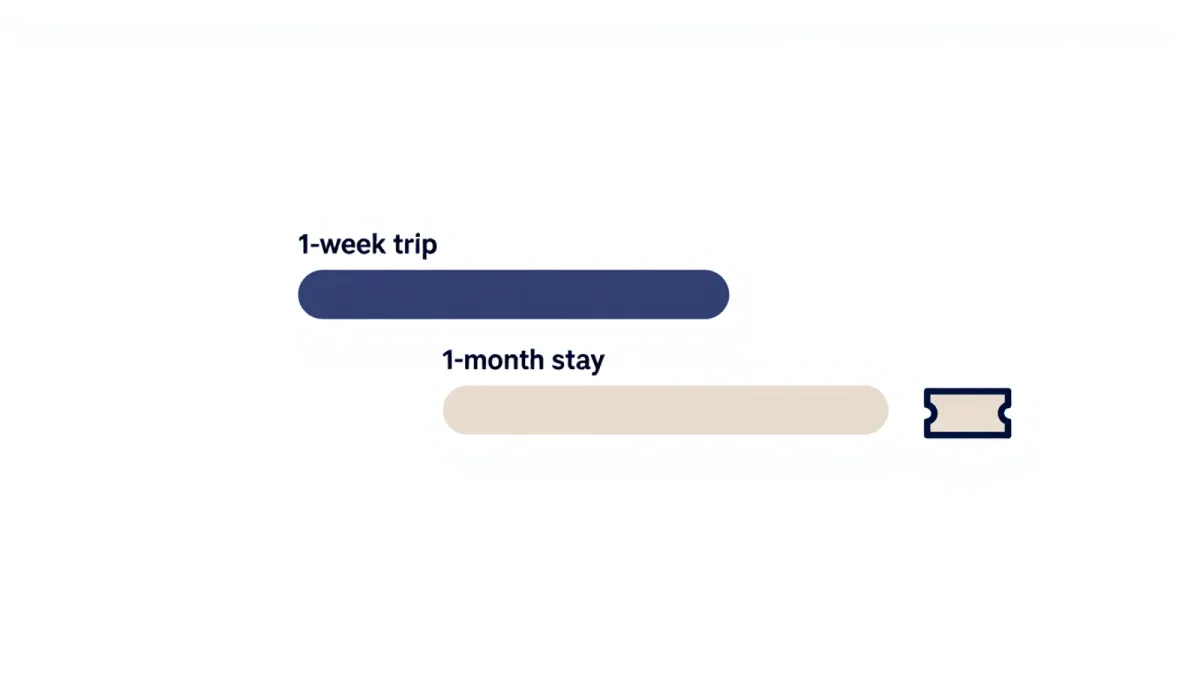
Slow travel sounds expensive — more days must mean more money — but the arithmetic works the other way once the fixed costs of moving are amortized. A one-week trip concentrates flights, transfers and city-center hotels into seven pricey days; a month in one place dilutes those costs and unlocks three structural discounts at once: monthly lodging rates, flat-rate regional transport, and cooking instead of restaurant weeks. The comparison below uses documented, dated figures wherever they exist and clearly labeled ranges where they do not.
Where does the money actually go on a short trip?
Break any one-week trip down and three line items dominate: the flight, the accommodation, and the food purchased away from a kitchen. Two of the three are priced by the night and by the day, which is why short trips feel expensive relative to what they contain. Lodging platforms and serviced-apartment operators systematically discount monthly stays — commonly in the 30 to 50 percent range versus the nightly rate, a range visible on any major platform's monthly quote — because a month of guaranteed occupancy is worth less churn to the host. The discount is the first structural fact of slow travel: the calendar itself gets cheaper as it fills.
How much does month-long lodging really cost?
Documented anchors help. A studio outside the most central districts of mid-cost European cities — Porto, Thessaloniki, Leipzig, Pecs — routinely quotes in the €600–€1,000 monthly range on long-stay platforms, while comparable central short-stay pricing in the same cities can run €90–€140 a night. At four weeks, the nightly path costs roughly triple the monthly path for less space. Northern and capitol markets run higher and the discount compresses, but it does not disappear: monthly furnished listings in Berlin or Lyon still price far below 30 hotel nights. The reliable procedure is mechanical: pull the monthly quote and divide by 30, and compare it to the nightly quote multiplied by your true stay length.
What about transport?
Transport is where slow travel's math is most publicly documented. Germany's Deutschland-Ticket — unlimited regional and local transport nationwide — costs €63 a month as of January 1, 2026, per Deutsche Bahn, after €58 in 2025 and €49 at launch. A single flexible high-speed round trip inside Germany can approach that figure alone. Austria's KlimaTicket prices the national network annually at a monthly-equivalent rate far below two or three intercity returns, and similar flat-rate regional products exist in Switzerland (community and cantonal passes) and the Netherlands (region and season products). The pattern: slow travel substitutes a monthly flat fee for per-trip fares, and the flat fee wins anywhere the traveler moves more than twice a week.
And the food line?
A month with a kitchen converts the most elastic budget line into the most controllable one. Weekly market shops and cooking five of seven dinners is the single largest saving available to a traveler, and it is the one that only exists past the first week — a one-week trip's kitchen rarely pays for its overhead. Travelers who work this out tend to report the same secondary effect: the two restaurant meals a week that remain are chosen, not defaulted, and cost less attention as well as less money.
What does the full comparison look like?
As a planning model, not a quote: a one-week trip built on flights, nightly lodging and restaurants in a mid-cost European city can plausibly total €1,400–€2,200 for one person. A four-week slow version of the same region — monthly apartment at the discounted rate, one monthly transport pass at a documented flat rate, markets and a kitchen, one intercity move — commonly lands in the €2,000–€3,200 band. The month costs roughly 50 percent more than the week in absolute terms but delivers four times the days: the cost per day falls from roughly €200–€300 to €70–€110. That per-day figure, not the trip total, is the number slow travel lives on.
What does the math miss?
Three honest caveats. Income: a month away only pencils out for people whose work or savings travel with them, which is a real constraint the arithmetic cannot wave off. Momentum: monthly discounts punish itineraries that keep moving — the model assumes one base, maybe two. And visibility: short trips hide costs in annual budgets, while a month on the road puts every euro on one statement, which feels worse even when the total is better. The math favors slowness almost everywhere; the culture of counting still favors speed.How do you start running this math yourself?
One spreadsheet, five rows, thirty minutes. Pull the actual monthly quote from a long-stay platform for your candidate city and divide by 30; price one flat-rate transport pass at the operator published fare; estimate groceries at a weekly market basket times four; allow two restaurant meals a week; then set the whole thing against your shortest realistic high-speed alternative for the same dates. Every figure in the model is checkable in under an hour, which is precisely why the comparison is worth making before booking rather than after. Most travelers who run it once stop planning trips and start planning months — not because slow travel is a philosophy, but because the spreadsheet came back on one side and stayed there.